



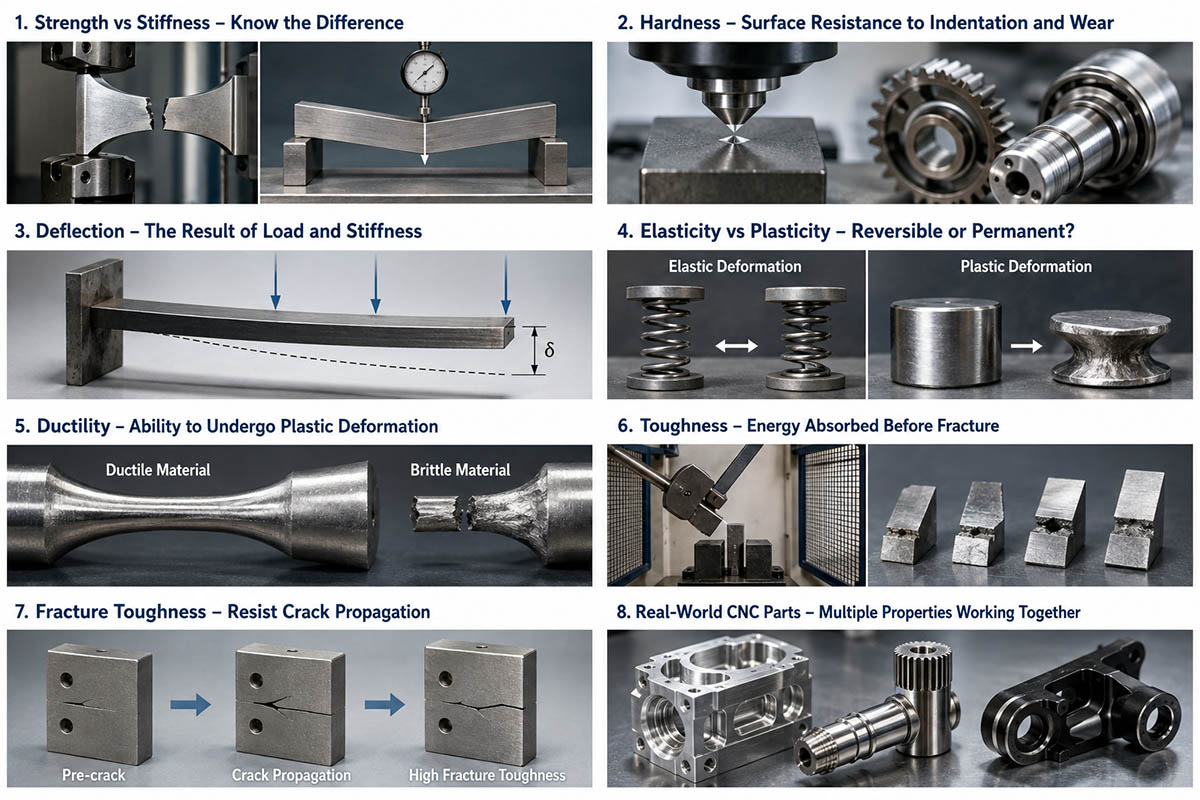
Mechanical engineers often use terms such as stiffness, strength, hardness, elasticity, plasticity, ductility, toughness, and fracture toughness when designing CNC machined components. However, these terms describe fundamentally different mechanical behaviors.
A material can be hard but brittle, soft but tough, strong but flexible, or elastic but not stiff. These combinations are not contradictory because each property answers a different engineering question.
For CNC Machining and mechanical component design, understanding these differences is critical for material selection, structural optimization, dimensional accuracy, fatigue resistance, wear resistance, and failure prevention.
The most important distinction is to separate material properties from structural responses.
For example, Young's modulus (E) is an intrinsic material property, while structural stiffness (k) depends on the material, geometry, span, and boundary conditions. Similarly, strength describes the stress level at which a material or specimen reaches a defined failure criterion, while deflection describes how much a specific component actually moves under load.
This guide explains the differences between these mechanical properties and shows how they affect CNC Machined Parts, precision components, mechanical structures, gears, shafts, fixtures, tooling, and industrial equipment.
1. Stiffness vs Strength: What Is the Difference?
The most common mistake in mechanical design is treating stiffness and strength as the same thing.
They are not.
What Is Stiffness?
Stiffness describes how strongly a component resists deformation when subjected to an external load.
For a simple linear loading condition:
where:
k = structural stiffness
F = applied force
δ = displacement or deformation
A high-stiffness component requires more force to produce the same amount of deformation.
For material stiffness, engineers commonly use Young's modulus (E):
where:
σ = stress
E = Young's modulus
ε = strain
Young's modulus is a material property, while structural stiffness is a property of a particular component.
What Determines Structural Stiffness?
Structural stiffness depends on:
Material elastic modulus
Cross-sectional geometry
Component thickness
Length or span
Boundary conditions
Loading direction
For example, consider a cantilever beam:
The equation demonstrates why geometry is so important.
For a rectangular beam, increasing its thickness can dramatically increase the second moment of area I, reducing deflection much more effectively than simply changing to another material with a moderately higher Young's modulus.
This is particularly important when designing CNC machined brackets, frames, plates, fixtures, machine bases, and structural components.
What Is Strength?
Strength describes a material's resistance to mechanical failure.
Common strength indicators include:
Yield strength
Ultimate tensile strength
Compressive strength
Bending strength
Shear strength
Fatigue strength
Strength answers:
How much stress can the material withstand before a defined failure or unacceptable permanent deformation occurs?
Stiffness answers a different question:
How much will the component deform under a given load?
Therefore:
High strength does not necessarily mean high stiffness.
2. Young's Modulus vs Structural Stiffness
This distinction is especially important in CNC component design.
Young's Modulus Is a Material Property
Young's modulus is normally expressed in:
GPa
MPa
For example, steel has a Young's modulus of approximately 200 GPa, while 6061-T6 aluminum is approximately 69 GPa.
This means steel is intrinsically much more resistant to elastic strain than aluminum under the same stress.
However, that does not mean every steel component is stiffer than every aluminum component.
Structural Stiffness Depends on Geometry
A properly designed aluminum component can be much stiffer than a poorly designed steel component if its geometry provides a substantially larger second moment of area.
This is why CNC designers often use:
Ribs
Gussets
Deeper sections
Box structures
I-beam structures
Optimized wall thickness
instead of simply switching to a higher-modulus material.
Engineering Rule
Material stiffness → look at Young's modulus E.
Structural stiffness → evaluate E + geometry + boundary conditions.
3. What Is Deflection?
Deflection is the actual displacement produced by a component under an applied load.
Unlike Young's modulus, deflection is not an intrinsic material property.
It is a structural response.
For a simply supported beam with a center load:
Deflection depends on:
Applied force F
Span length L
Young's modulus E
Second moment of area I
Support conditions
This explains why two CNC machined parts made from exactly the same aluminum alloy can have dramatically different deformation behavior.
A thick, short aluminum bracket may be extremely stable, while a thin, long aluminum plate may bend significantly.
Why Deflection Matters in CNC Machining
Excessive deflection can cause:
Dimensional errors
Misalignment
Vibration
Tool interference
Poor surface finish
Reduced positioning accuracy
Assembly problems
Reduced equipment stability
For precision CNC components, controlling deflection can therefore be more important than maximizing ultimate strength.
4. Hardness vs Strength: Are They the Same?
Hardness and strength are related, but they are not interchangeable.
What Is Hardness?
Hardness describes a material's resistance to localized indentation, scratching, and surface deformation.
Common hardness scales include:
Brinell hardness — HB
Rockwell hardness — HRC
Vickers hardness — HV
Hardness is particularly important for:
Cutting tools
Gears
Bearing surfaces
Shafts
Guide rails
Wear-resistant components
Mold components
Hardness Is a Local Surface Property
A hardness test applies a localized force to a small region of the material.
Strength, by contrast, describes the material's resistance to a broader mechanical failure mode.
For some steels, hardness and tensile strength have useful empirical correlations. However, these correlations should not be universally applied to:
Ceramics
Polymers
Coatings
Composite materials
Dissimilar material systems
Therefore:
Hardness ≠ strength.
A material can have high hardness but poor fracture resistance.
5. Elasticity: Can the Material Return to Its Original Shape?
Elasticity describes the ability of a material to recover its original shape after the load is removed.
Within the elastic range:
The deformation is reversible.
If the material is unloaded before reaching its elastic limit, the strain can largely recover without permanent deformation.
Elasticity Does Not Mean High Stiffness
This is another common misconception.
Rubber can undergo very large deformation while remaining substantially elastic.
Therefore:
Elasticity asks:
Can the material recover after unloading?
Stiffness asks:
How much force is required to produce a given deformation?
A material can be highly elastic while having a relatively low Young's modulus.
6. Plasticity: What Happens After Elastic Deformation?
Plasticity describes a material's ability to undergo permanent deformation without immediate fracture.
When stress exceeds the yield condition, the material may enter the plastic deformation region.
After unloading, part of the deformation remains as residual strain.
This is fundamentally different from elastic deformation.
Elastic Deformation
Reversible
No permanent dimensional change
Occurs below the relevant elastic/yield limit
Plastic Deformation
Irreversible
Leaves residual strain
Occurs after yielding
Can involve dislocation movement and other irreversible mechanisms
Plasticity is important in:
Sheet Metal forming
Forging
Stamping
Bending
Rolling
Metal forming
Machining-induced deformation
A material with good plasticity can undergo substantial permanent deformation before fracture.
7. Ductility vs Plasticity
Ductility is a specific manifestation of plasticity, particularly under tensile loading.
Ductility is commonly evaluated using:
Percentage elongation
Reduction of area
For example, a highly ductile metal can undergo significant elongation before fracture.
However, ductility does not automatically mean high toughness.
A material may undergo considerable deformation but still have limited ability to resist crack propagation or absorb impact energy.
Therefore:
Ductility describes deformation capacity, while toughness describes energy absorption before fracture.
8. Toughness: How Much Energy Can a Material Absorb?
Toughness describes a material's ability to absorb mechanical energy before fracture.
For a tensile specimen, toughness can be related to the area under the stress-strain curve up to fracture:
The resulting quantity represents energy absorbed per unit volume.
A tough material generally combines:
Adequate strength
Significant plastic deformation capacity
Resistance to fracture
This is why toughness should not be confused with ductility.
Ductility vs Toughness
A ductile material can deform substantially before breaking.
A tough material can absorb substantial energy before breaking.
The two properties are related, but they are not identical.
For mechanical components exposed to impact or dynamic loads, toughness can be critical.
Examples include:
Gears
Shafts
Connecting rods
Automotive components
Industrial machine structures
Construction equipment components
9. Fracture Toughness: What If a Crack Already Exists?
Fracture toughness is different from ordinary toughness.
Fracture toughness describes a material's resistance to unstable crack propagation when a crack or sharp defect already exists.
A commonly used plane-strain fracture toughness parameter is:
with units of:
MPa·√m
Fracture toughness becomes particularly important for components containing:
Machining notches
Sharp corners
Surface scratches
Internal defects
Porosity
Welding defects
Fatigue cracks
Stress concentrations
A component can have good tensile properties and still perform poorly when a crack is present.
Therefore:
High toughness does not automatically guarantee high fracture toughness.
10. Brittleness vs Hardness
Brittleness describes a tendency to fracture with little obvious plastic deformation.
It is not simply another word for hardness.
For example, glass can have relatively high hardness but very low resistance to crack propagation.
Brittleness can also depend on:
Temperature
Strain rate
Stress state
Notch geometry
Microstructure
Defect population
This means:
Hard ≠ brittle
and:
Soft ≠ tough
These properties must be evaluated independently.
11. Stiffness, Strength, Hardness, Toughness and Other Properties Compared
| Property | Main Question | Typical Indicator | Engineering Level | CNC Design Meaning |
|---|---|---|---|---|
| Young's Modulus | How resistant is the material to elastic strain? | GPa | Material | Determines intrinsic elastic stiffness |
| Stiffness | How much force causes a certain displacement? | N/mm | Structure | Controls deformation of the finished part |
| Deflection | How much does the component actually move? | mm | Structure | Determines dimensional and positional accuracy |
| Strength | When will yielding or failure occur? | MPa | Material/specimen | Determines load-bearing and failure limits |
| Hardness | How resistant is the surface to indentation or scratching? | HB/HRC/HV | Material/specimen | Important for wear resistance |
| Elasticity | Will deformation recover after unloading? | — | Material | Determines reversible deformation |
| Plasticity | Can the material permanently deform without immediate fracture? | Residual strain | Material | Important for forming and deformation behavior |
| Ductility | How much tensile plastic deformation can occur before fracture? | Elongation % | Specimen | Indicates tensile deformation capacity |
| Toughness | How much energy can be absorbed before fracture? | J/m³ | Specimen/material | Important for impact resistance |
| Fracture Toughness | How well does the material resist crack growth? | KIC, MPa√m | Specimen/material | Critical for notched or cracked components |
| Rigidity | Is the structure qualitatively resistant to deformation? | Qualitative | Structure/material | Describes overall resistance to deformation |
12. Typical Mechanical Properties of Common Engineering Materials
Different engineering materials provide very different combinations of stiffness, strength, hardness, ductility, and toughness.
| Material | Young's Modulus | Strength | Hardness | Ductility | Typical Engineering Advantage |
|---|---|---|---|---|---|
| Q235 Structural Steel | ~200–210 GPa | 235 MPa yield | ~140 HB | ~24–26% | Good ductility and impact resistance |
| 45 Steel | ~200–210 GPa | ~355 MPa yield / ~600 MPa tensile | ~220 HB or 50–55 HRC after hardening | Moderate | Balanced strength, machinability and wear resistance |
| 6061-T6 Aluminum | ~68–70 GPa | ~276 MPa yield | ~95 HB | ~12–17% | Low weight and good machinability |
| TC4 / Ti-6Al-4V | ~110–115 GPa | ~860–900 MPa yield | ~330 HB | ~10–14% | High specific strength and corrosion resistance |
| T300 Carbon Fiber Composite | ~130–150 GPa longitudinally | ~1500–1800 MPa tensile | Not directly comparable | Very low | High specific stiffness and strength |
These values are representative rather than universal design values. Actual properties depend on material grade, heat treatment, manufacturing process, orientation, specimen condition, and applicable standards.
13. How to Choose Materials for CNC Machined Parts
Material selection should begin with the dominant failure mode, rather than simply choosing the material with the highest strength or hardness.
13.1 For High Precision and Low Deflection: Prioritize Stiffness
If a CNC component must maintain tight dimensional or positional tolerances, focus on:
Young's modulus
Structural stiffness
Section geometry
Support conditions
Deflection
Typical applications include:
Machine bases
Precision fixtures
Linear guide supports
CNC machine components
Inspection fixtures
Precision brackets
A lightweight aluminum component can often achieve excellent stiffness through optimized geometry, even though aluminum has only about one-third the Young's modulus of steel.
13.2 For Heavy Loads: Prioritize Strength
For components that must withstand high mechanical loads, consider:
Yield strength
Tensile strength
Fatigue strength
Shear strength
Safety factor
Typical examples include:
Load-bearing brackets
Drive shafts
Structural supports
Transmission components
High-load CNC machined parts
Titanium alloys such as Ti-6Al-4V are attractive for applications requiring high specific strength because they combine relatively low density with high strength.
13.3 For Wear Resistance: Prioritize Hardness
If the primary problem is surface wear, look at:
Hardness
Surface treatment
Contact stress
Lubrication
Wear mechanism
For example, hardened 45 steel can achieve substantially higher surface hardness through appropriate heat treatment while maintaining a tougher core.
Typical applications include:
Gears
Shafts
Guide components
Mold components
Wear plates
Tooling
13.4 For Impact Resistance: Prioritize Toughness
For components subjected to impact or sudden loading, material selection should consider:
Toughness
Ductility
Fracture toughness
Notch sensitivity
Fatigue behavior
This is particularly important for:
Gears
Connecting rods
Automotive components
Engineering machinery
Shock-loaded structures
A material with extremely high strength but poor fracture resistance may not be the best choice for an impact-loaded component.
13.5 For Forming and Deformation: Prioritize Plasticity
If the manufacturing process requires substantial permanent deformation, select materials with suitable plasticity.
This matters in:
Bending
Stamping
Forging
Rolling
Sheet Metal forming
Good plasticity helps a material deform without premature cracking.
13.6 For Spring and Return Functions: Consider Elastic Behavior
For springs and elastic elements, designers need to consider:
Elastic modulus
Yield strength
Elastic limit
Fatigue strength
Recoverable strain
Spring steels are commonly selected because they can withstand repeated elastic deformation without excessive permanent set.
14. Practical Examples: Why These Properties Should Not Be Confused
Example 1: Steel vs Aluminum
Steel generally has a much higher Young's modulus than aluminum.
For identical beam geometry and loading:
Steel → smaller elastic deflection
Aluminum → larger elastic deflection
However, aluminum can be redesigned with a deeper or ribbed cross-section to significantly increase its structural stiffness while reducing weight.
This is why CNC engineers should evaluate the entire component rather than comparing materials using one property.
Example 2: Hard Steel vs Tough Steel
A hardened steel component may have excellent surface hardness and wear resistance.
However, excessive hardness can sometimes be associated with reduced ductility and increased brittleness, depending on grade and heat treatment.
For gears and shafts, designers often need to balance:
Surface hardness + core toughness + fatigue resistance
rather than maximizing hardness alone.
Example 3: Rubber vs Steel
Rubber can undergo large elastic deformation.
Steel usually deforms much less under the same stress level.
This does not mean rubber is “stiffer.”
It illustrates the difference between:
Elasticity = ability to recover
and
Stiffness = resistance to deformation
Example 4: Carbon Fiber vs Metal
Carbon fiber composites can provide very high specific stiffness and tensile strength along the fiber direction.
However, their properties are strongly directional.
A unidirectional carbon-fiber laminate can have dramatically different mechanical properties along and transverse to the fiber direction.
This is fundamentally different from isotropic metals such as conventional steel and aluminum alloys.
15. A Simple Engineering Decision Matrix
When selecting a material for CNC machined components, start with the engineering requirement:
| Design Requirement | Primary Property |
|---|---|
| Minimize bending | Stiffness / Young's modulus |
| Minimize elastic deflection | Structural stiffness |
| Prevent yielding | Yield strength |
| Prevent tensile fracture | Ultimate tensile strength |
| Resist surface wear | Hardness |
| Resist scratching | Hardness |
| Absorb impact energy | Toughness |
| Resist crack propagation | Fracture toughness |
| Allow permanent forming | Plasticity |
| Allow large tensile elongation | Ductility |
| Recover after loading | Elasticity |
| Reduce actual component displacement | Structural stiffness + geometry |
16. The Golden Rules for CNC Mechanical Design
Several simple rules can prevent most terminology mistakes.
Rule 1: Stiffness Is Not Strength
Stiffness = resistance to deformation.
Strength = resistance to failure.
A component can be strong enough not to break but too flexible to meet its dimensional tolerance.
Rule 2: Young's Modulus Is Not Structural Stiffness
Young's modulus is a material property.
Structural stiffness depends on:
Material + geometry + boundary conditions + loading
Rule 3: Deflection Is a Result, Not a Material Property
Deflection tells engineers how much a specific structure moves under a specific load.
It depends on the entire mechanical system.
Rule 4: Hardness Is Not Strength
Hardness primarily describes localized resistance to indentation and scratching.
Strength describes resistance to defined mechanical failure modes.
Rule 5: Elasticity Is Not Stiffness
A material can be highly elastic and still deform significantly.
Elasticity concerns recovery.
Stiffness concerns resistance to deformation.
Rule 6: Ductility Is Not Toughness
Ductility describes how much plastic deformation a material can sustain before fracture.
Toughness describes how much energy it can absorb before fracture.
Rule 7: Toughness Is Not Fracture Toughness
Ordinary toughness generally concerns energy absorption before fracture.
Fracture toughness specifically addresses crack propagation resistance when a crack or sharp defect already exists.
17. Why These Mechanical Properties Matter in CNC Machining
For CNC machined components, material selection cannot be based solely on machinability or tensile strength.
A successful design must balance:
Dimensional stability
Structural stiffness
Strength
Hardness
Wear resistance
Toughness
Fatigue resistance
Corrosion resistance
Weight
Machinability
Manufacturing cost
For example, a precision CNC fixture may require high stiffness and dimensional stability rather than extremely high tensile strength.
A gear may prioritize surface hardness, fatigue strength, and core toughness.
A lightweight aerospace component may prioritize specific strength and specific stiffness.
A robotic arm component may require a balance between stiffness, weight, fatigue resistance, and fracture toughness.
Therefore, there is no universally “best” material. The optimal CNC material is determined by the component's load case, geometry, operating environment, failure mode, tolerance requirements, and manufacturing process.
Stiffness, strength, hardness, elasticity, plasticity, ductility, toughness, and fracture toughness describe different aspects of mechanical behavior.
The easiest way to remember them is:
Stiffness asks: “How much will it deform?”
Strength asks: “When will it yield or fail?”
Hardness asks: “How resistant is the surface to indentation or scratching?”
Elasticity asks: “Will it recover after unloading?”
Plasticity asks: “Can it permanently deform without immediate fracture?”
Ductility asks: “How much tensile plastic deformation can it sustain?”
Toughness asks: “How much energy can it absorb before fracture?”
Fracture toughness asks: “How well can it resist crack propagation?”
For CNC mechanical design, the practical rule is simple:
Use modulus and structural analysis to control deformation, strength values to prevent failure, hardness to control surface wear, plasticity and ductility to evaluate forming behavior, and toughness/fracture toughness to control impact and crack-related failure.
Understanding these distinctions allows engineers to select materials more accurately, optimize CNC component geometry, reduce unnecessary material costs, and design mechanical parts that are both reliable and fit for their intended application.


