



magnesium alloy welding is a hot topic in the industry. Component manufacturers often report issues like porosity and cracking that hinder yield rates, while professionals frequently ask which welding processes suit specific magnesium alloy parts, what the pros and cons of mainstream technologies are, and how to avoid common pitfalls. As a factory specializing in magnesium alloy lightweighting, Huazheng Precision has compiled a comprehensive breakdown of the welding defects and ten key welding processes that matter most to you. We aim to fully explain the causes of defects, solutions, and ideal application scenarios for each process, helping you overcome the challenges of magnesium alloy welding.
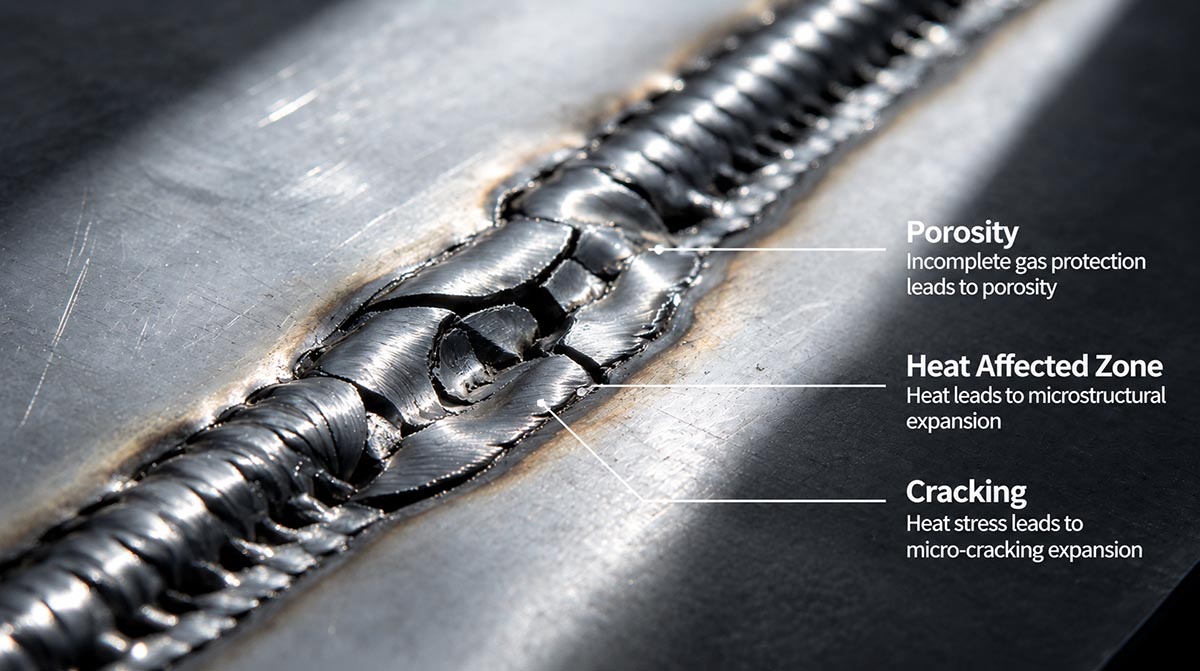
I. Challenges and Common Defects in Magnesium Alloy Welding
1. Characteristics of Magnesium Alloy Welding
Magnesium alloys are characterized by low density, low melting point, high thermal conductivity, large coefficient of thermal expansion, and strong chemical reactivity. Because magnesium is easily oxidized, and oxides have high melting points, a series of problems easily arise during welding, requiring high levels of process control.
2. Main Problems in Magnesium Alloy Welding
(1) Grain Coarsening
Magnesium alloys have high thermal conductivity, requiring a large heat input during welding. This easily leads to overheating of the weld and heat-affected zone, causing grain growth and microstructure segregation, thereby reducing the performance of the weld joint.
(2) Oxidation and Evaporation
Magnesium has strong oxidizing properties, easily forming magnesium oxide (MgO) during welding.
MgO has:
High melting point (approximately 2500℃);
High density (approximately 3.2 g/cm³).
It easily forms slag inclusions in the weld, affecting weld formation and performance. Meanwhile, magnesium readily reacts with nitrogen in the air at high temperatures to form magnesium nitride, reducing weld plasticity. Furthermore, due to magnesium's low boiling point (approximately 1100℃), it is prone to evaporation during high-temperature welding.
(3) Burn-through and Collapse in Thin-Walled Parts
Magnesium alloys have a low melting point, while magnesium oxide has a very high melting point, making them difficult to fuse. When welding thin-walled parts, the molten pool is difficult to observe, and defects such as burn-through and collapse are easily caused by excessively high temperatures.
(4) Thermal Stress and Cracking
Magnesium alloys have a large coefficient of thermal expansion:
approximately twice that of steel;
approximately 1.2 times that of aluminum.
This easily generates significant stress and deformation during welding.
Simultaneously, magnesium readily forms low-melting-point eutectic structures with elements such as Cu, Al, and Ni, leading to hot cracks at grain boundaries. For example:
Mg-Cu eutectic temperature is approximately 480℃;
Mg-Al eutectic temperature is approximately 430℃;
Mg-Ni eutectic temperature is approximately 508℃.
(5) Porosity
Hydrogen porosity is easily generated during the welding of magnesium alloys.
Since the solubility of hydrogen in magnesium decreases rapidly with decreasing temperature, it easily precipitates and forms pores during cooling, affecting the strength and reliability of the weld.
(6) Oxidation and Combustion
Magnesium and magnesium alloys are prone to oxidation and even combustion when welded in air. Therefore, the following should be used during fusion welding:
Inert gas protection (Ar, He);
Special flux protection.
To reduce oxidation, cracks, and welding defects.
II. Common Welding Processes for Magnesium Alloys
Common welding methods for magnesium alloys include tungsten inert gas (TIG) welding and metal inert gas (MIG) welding. In addition, resistance spot welding (RSW), friction welding (FW), friction stir welding (FSW), laser welding (LBW), and electron beam welding (EBW) can also be used.
Due to the low specific heat capacity and low latent heat of fusion of magnesium alloys, relatively low heat input is required for welding, while high welding speeds are necessary. In actual production, magnesium alloys are typically welded using fusion welding methods such as arc welding, laser welding, and electron beam welding.
1. Tungsten Inert Gas Welding (TIG)
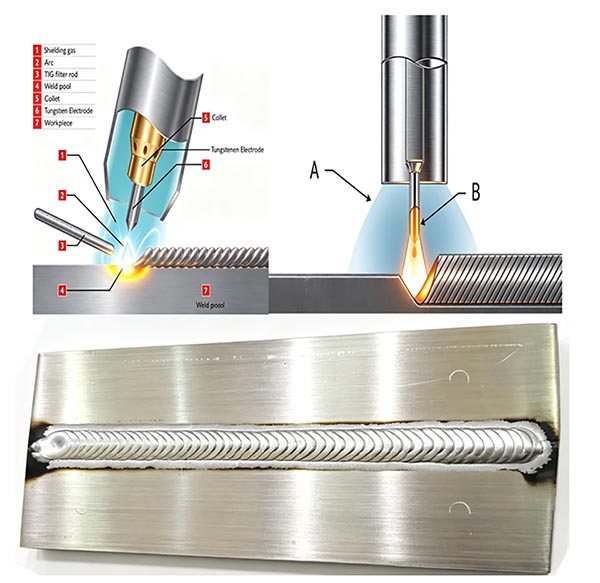
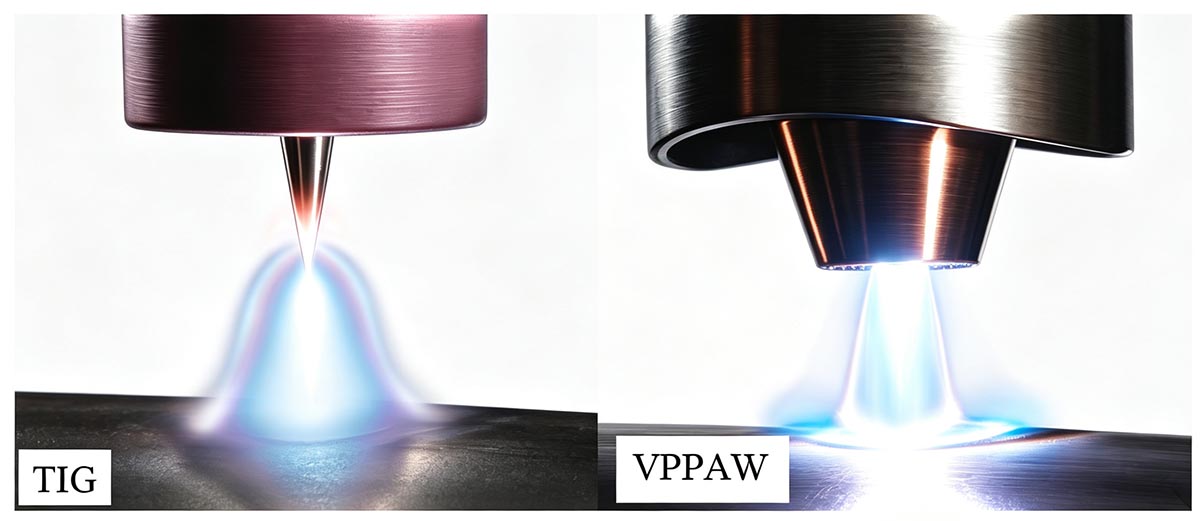
Tungsten inert gas welding is currently the most widely used welding method for magnesium alloys. This process melts the base metal and filler metal through the heat of an electric arc under inert gas protection.
When welding with direct current, a reverse polarity connection is used, utilizing cathode atomization to remove the oxide film on the material surface, reducing oxide inclusions in the weld.
TIG welding offers the following advantages:
Small heat-affected zone;
Low welding deformation;
Good weld mechanical properties and corrosion resistance.
TIG welding can be performed with or without filler metal. Due to independent control of the electrode and filler wire, it has a wider process adaptability range compared to MIG welding, making it more suitable for magnesium alloy welding, especially for thin magnesium alloy sheet processing.
However, due to the large coefficient of thermal expansion of magnesium alloys, cracks and deformation are prone to occur during welding. Therefore, measures such as fixture fixation, beveling design, and pre- and post-weld heat treatment are required.
Studies have shown that AC TIG welding of AZ31B magnesium alloy thin plates may result in defects such as wavy deformation, misalignment, weld beads, surface pitting, and crater cracks. By optimizing the welding sequence, using high current for rapid welding, and rigid fixation, better weld joints can be obtained, with joint strength reaching over 80% of the base metal.
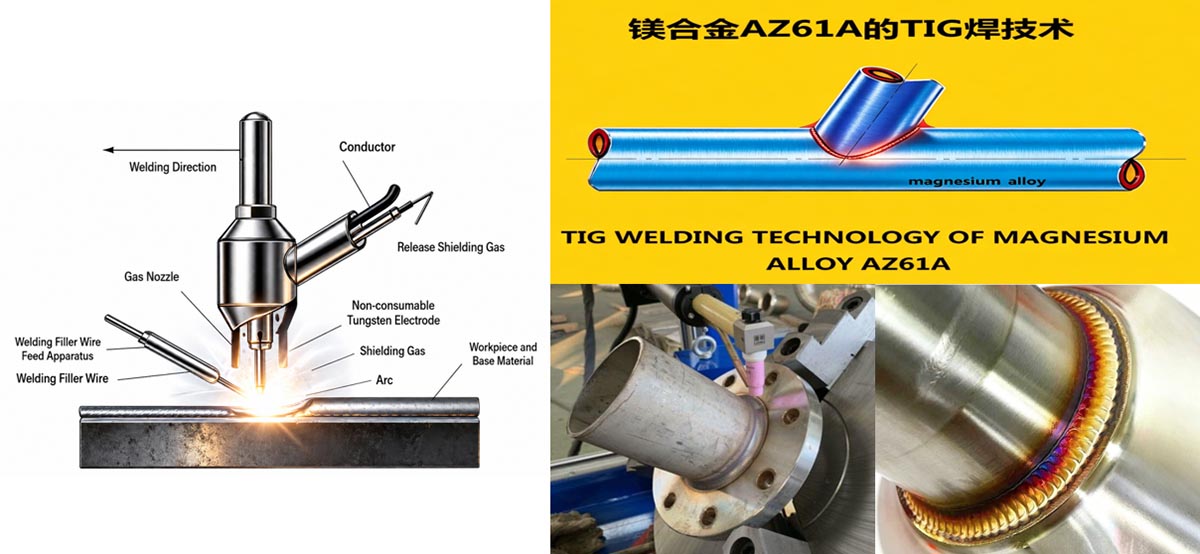
2. Active Tungsten Inert Gas Welding (A-TIG)
For welding thick magnesium alloy plates, active tungsten inert gas welding (A-TIG) is typically used to improve penetration depth. This method involves coating the material surface with an activator before welding, such as:
TiO₂, LiCl, CaCl₂, CdCl₂, PbCl₂, CeCl₃. The activator increases the arc temperature and voltage, improves heat flow distribution, and increases weld penetration by approximately two times compared to conventional TIG welding.
A-TIG welding achieves excellent weld fusion, reduces defects such as cracks, porosity, and slag inclusions, and improves the welding quality of thick magnesium alloy plates. Its main principle is to improve welding efficiency by altering the arc characteristics, increasing heat input while optimizing heat distribution.
Magnesium alloy TIG welding typically uses an AC welding machine or an adjustable DC welding machine. The power supply selection depends primarily on the base material composition, plate thickness, and welding conditions. Thin plates can use AC or DCEP power supplies, while AC welding is more advantageous for thick plates (greater than 4.18mm) due to its greater penetration. AC welding usually requires the addition of high-frequency pulses for arc stabilization, while square wave AC can directly achieve good cathode atomization. TIG welding electrodes are selected according to the power supply type and welding current. Commonly used electrodes include pure tungsten electrodes, zirconium tungsten electrodes, and thorium tungsten electrodes with a diameter of Φ0.25mm to 6.35mm.
Process parameters for manual tungsten inert gas welding of Huazheng pure aluminum and its alloys
| Material Thickness (mm) | Filler Wire Diameter (mm) | Tungsten Electrode Diameter (mm) | Preheating Temperature (℃) | Welding Current (A) | Shielding Gas Flow Rate (L/min) | Nozzle Bore Diameter (mm) | Welding Passes (Front / Back) | Remarks |
|---|---|---|---|---|---|---|---|---|
| 1 | 1.6 | 2 | — | 45~60 | 7~9 | 8 | 1 Front | Edge Roll Weld |
| 1.5 | 1.6~2.0 | 2 | — | 50~80 | 7~9 | 8 | 1 Front | Edge Roll or Single-Sided Butt Weld |
| 2 | 2~2.5 | 2~3 | — | 90~120 | 8~12 | 8~12 | 1 Front | Butt Weld |
| 3 | 2~3 | 3 | — | 150~180 | 8~12 | 8~12 | 1 Front | V-Groove Butt Weld |
| 4 | 3 | 4 | — | 180~200 | 10~15 | 8~12 | 1~2 Front / 1 Back | V-Groove Butt Weld |
| 5 | 3~4 | 4 | — | 180~240 | 10~15 | 10~12 | 1~2 Front / 1 Back | V-Groove Butt Weld |
| 6 | 4 | 5 | — | 240~260 | 16~20 | 14~16 | 1~2 Front / 1 Back | V-Groove Butt Weld |
| 8 | 4~5 | 5 | 100 | 260~320 | 16~20 | 14~16 | 2 Front / 1 Back | V-Groove Butt Weld |
| 10 | 4~5 | 5 | 100~150 | 280~340 | 16~20 | 14~16 | 3~4 Front / 1~2 Back | V-Groove Butt Weld |
| 12 | 4~5 | 5~6 | 150~200 | 340~360 | 18~22 | 16~20 | 3~4 Front / 1~2 Back | V-Groove Butt Weld |
| 14 | 5~6 | 5~6 | 180~200 | 340~380 | 20~24 | 16~20 | 3~4 Front / 1~2 Back | V-Groove Butt Weld |
| 16 | 5~6 | 6 | 200~220 | 340~380 | 20~24 | 16~20 | 4~5 Front / 1~2 Back | V-Groove Butt Weld |
| 18 | 5~6 | 6 | 200~240 | 360~400 | 25~30 | 16~20 | 4~5 Front / 1~2 Back | V-Groove Butt Weld |
| 20 | 5~6 | 6 | 200~260 | 360~400 | 25~30 | 20~22 | 4~5 Front / 1~2 Back | V-Groove Butt Weld |
| 16~20 | 5~6 | 6 | 200~280 | 300~380 | 25~30 | 16~20 | 2~3 Front / 2~3 Back | Double V-Groove Butt Weld |
| 22~25 | 5~6 | 6~7 | 200~280 | 360~400 | 30~35 | 20~22 | 3~4 Front / 3~4 Back | Double V-Groove Butt Weld |
3. Metal Inert Gas (MIG)
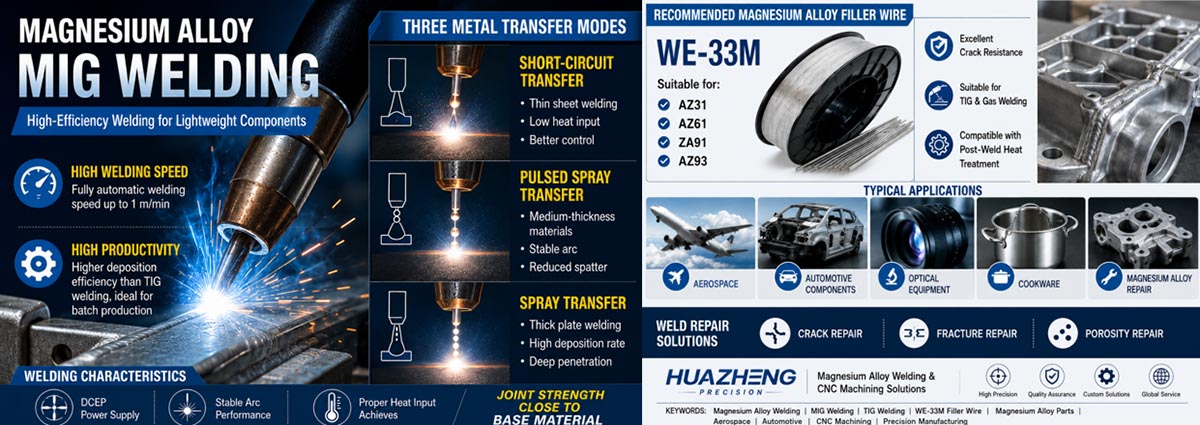
Welding Compared to TIG welding, MIG welding of magnesium alloys offers faster welding speeds and higher production efficiency, with fully automated welding speeds reaching approximately 1 m/min. However, due to the wire as the electrode, the welding parameter range is narrower, and the low surface tension of molten magnesium makes it difficult for droplets to detach, leading to spatter and evaporation at excessively high currents. Additionally, magnesium welding wire is relatively soft, resulting in poor wire feeding stability, typically requiring a push-pull wire feeder.
There are three main droplet transfer methods in magnesium alloy MIG welding: short-circuit transfer, pulse jet transfer, and spray transfer. The transfer method is influenced by factors such as welding current, wire feed speed, wire diameter, and melting rate. Short-circuit transfer is suitable for thin plate welding, pulse jet transfer for medium-thickness plates, and spray transfer for thick plate welding. Magnesium alloy MIG welding typically uses a DCEP power supply; proper selection of the welding power supply and heat input can yield weld joints with strength close to that of the base material.
Magnesium Alloy MIG/TIG Welding Wire Selection Commonly used magnesium alloy welding wires include WE-33M, etc. WE-33M magnesium alloy welding wire exhibits excellent crack resistance and is suitable for welding common magnesium alloys such as AZ31, AZ61, ZA91, and AZ93. It can be used for gas welding and TIG welding. This welding wire is widely used in aerospace, automotive parts, optical instruments, kitchenware, and civilian magnesium products, and is suitable for repairing cracks, fractures, and porosity defects in magnesium alloys, while also meeting subsequent heat treatment requirements.
4. Magnesium Alloy TIG Welding
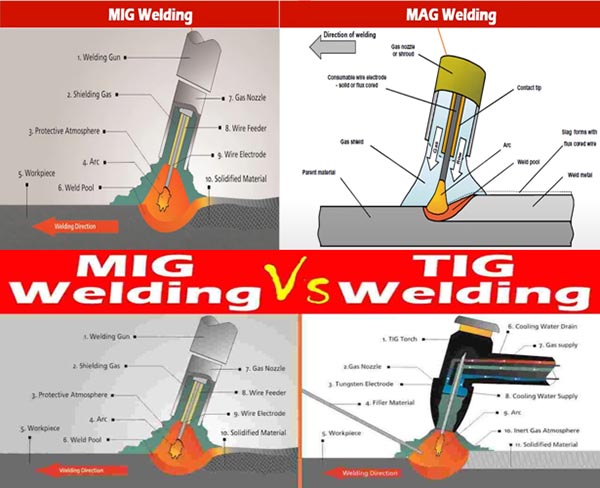
Magnesium alloy TIG welding is a welding process that uses argon gas as a shielding gas. It mainly includes tungsten inert gas (TIG) welding and metal inert gas (MIG) welding. This process protects the welding area with an inert gas, preventing oxidation of the magnesium alloy at high temperatures and improving weld quality and joint performance.
 1. Characteristics of TIG Welding
Magnesium alloy TIG welding typically uses AC welding machines or adjustable DC welding machines and is suitable for welding thin plates and precision parts. Its characteristics include:
Stable welding process and good weld formation;
Suitable for thin-walled structures and high-quality welding requirements;
AC power supply has a strong cathode cleaning effect, which can remove oxide films;
Common electrodes include pure tungsten electrodes, zirconium tungsten electrodes, and thorium tungsten electrodes.
2. Characteristics of MIG Welding
Magnesium alloy MIG welding uses a continuous wire feeding method, has high welding efficiency, and is suitable for automated production.
Key Features:
High welding speed and production efficiency;
Suitable for medium and heavy plates and mass production;
Droplet transfer methods include short-circuit transfer, pulse jet transfer, and jet transfer;
High-strength welded joints can be obtained by properly controlling the welding current, wire feed speed, and heat input.
3. Welding Material Selection
Commonly used magnesium alloy welding wires include WE-33M magnesium alloy welding wire, suitable for common magnesium alloys such as AZ31, AZ61, and AZ91.
5. Magnesium Alloy Plasma Arc Welding
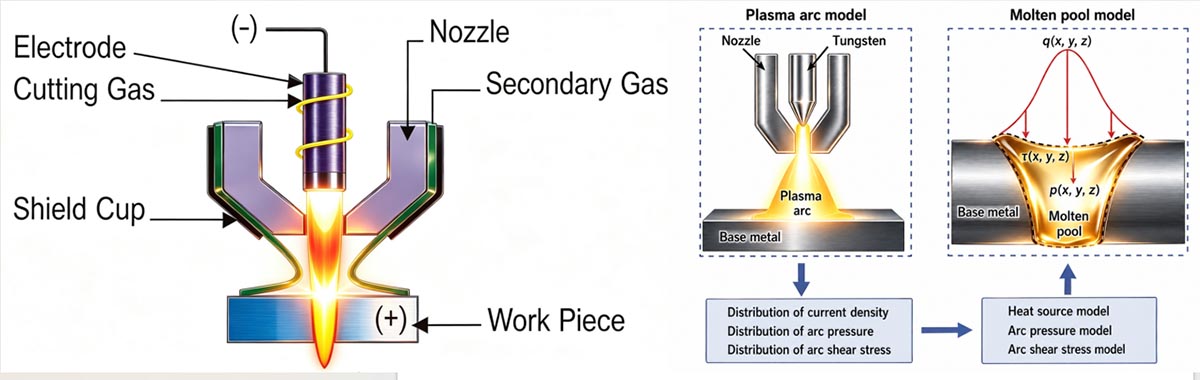
Magnesium alloy plasma arc welding is a welding method that utilizes a **compressed electric arc (Plasma Arc)**. Compared to a conventional arc, the plasma arc has higher temperature and energy density, stronger arc concentration, and higher penetration capability, making it suitable for welding thick plates and achieving deep penetration.
Main Features:
High plasma arc energy density and deep penetration, suitable for thick plate welding;
Achieves full penetration of thick plates in a single pass without a backing plate;
Smooth weld surface and good weld quality;
Welded joints exhibit good fatigue performance.
Influence of Welding Parameters: Magnesium alloy variable polarity plasma arc welding is relatively sensitive to parameter changes, with a relatively narrow adjustable range. By adjusting the ratio of positive and negative polarity time, the cathode cleaning effect of the workpiece can be altered, thereby affecting weld quality and joint strength.
Welding Performance: With proper selection of welding current, polarity ratio, and heat input parameters, excellent welded joints can be obtained, with tensile strength reaching over 90% of the base metal strength.
6. Magnesium Alloy Gas Welding
Magnesium alloy gas welding uses an oxy-fuel flame as a heat source. The equipment is simple, but due to the dispersed heat distribution and wide heating area, it easily generates significant welding shrinkage stress, leading to defects such as cracks. Therefore, gas welding is mainly used for on-site repair, thin-plate components, and repair welding of magnesium alloy castings.
Process Characteristics:
Large heat input range, resulting in significant welding deformation and stress;
Fluoride residue may cause slag inclusions and corrosion, requiring thorough cleaning after welding;
The commonly used flux is QJ401 magnesium alloy flux, which has good processability but is highly corrosive.
Welding Requirements:
Thin plate (<3mm): the="" welding="" torch="" and="" wire="" should="" be="" moved="" longitudinally="">
Thicker plate welding: Lateral oscillation is permissible;
Thickness > 5mm: Preheating to 300–400℃ is required before welding;
Thickness > 12mm: Multi-layer welding is recommended, with slag removed before each layer. Precautions: During the welding process, welding wire can be used to stir the molten pool, break the surface oxide film, and help remove welding slag, thereby improving the quality of the weld.
Flame Reference Table for Gas Welding of Common Metal Materials
| Welding Material | Applicable Flame | Welding Material | Applicable Flame |
|---|---|---|---|
| Low Carbon Steel | Neutral Flame or Slightly Oxidizing Flame | Nickel Stainless Steel | Neutral Flame or Slightly Carburizing Flame |
| Medium Carbon Steel | Neutral Flame or Slightly Oxidizing Flame | Purple Copper | Neutral Flame |
| Low Alloy Steel | Neutral Flame | Tin Bronze | Slightly Oxidizing Flame |
| High Carbon Steel | Slightly Carburizing Flame | Yellow Copper | Oxidizing Flame |
| Gray Cast Iron | Carburizing Flame or Slightly Carburizing Flame | Aluminum & aluminum alloy | Neutral Flame or Slightly Carburizing Flame |
| High Speed Steel | Carburizing Flame | Lead, Tin | Carburizing Flame or Slightly Carburizing Flame |
| Manganese Steel | Slightly Carburizing Flame | Nickel | Carburizing Flame or Slightly Carburizing Flame |
| Galvanized Iron Sheet | Slightly Carburizing Flame | Aluminum Bronze | Carburizing Flame |
| Stainless Steel | Neutral Flame or Slightly Oxidizing Flame | Hard Alloy | Carburizing Flame |
7. Magnesium Alloy Laser Welding
Magnesium alloy laser welding is a highly efficient and precise welding technology that utilizes a high-energy-density laser beam as a heat source. Compared to traditional fusion welding methods, laser welding offers advantages such as low heat input, high welding speed, and high precision, making it suitable for manufacturing high-performance magnesium alloy structural components.
Main Features:
High laser energy density, deep penetration, and narrow weld width;
Narrow heat-affected zone, low residual stress, and minimal welding deformation;
Fine weld microstructure and excellent joint performance;
No vacuum environment required, flexible shielding gas selection;
The laser beam can be transmitted via fiber optics or deflection devices, enabling welding in complex positions;
Easy to achieve three-dimensional automated welding.
Welding Performance: By optimizing laser power, welding speed, focal point position, and shielding gas parameters, magnesium alloy laser welding can effectively reduce defects such as porosity and undercut.
Studies have shown that:
The strength of deformed magnesium alloy laser-welded joints can approach that of the base material;
High weld quality with excellent mechanical properties;
Suitable for precision, high-strength magnesium alloy structural connections.
 8. Magnesium alloy laser-TIG hybrid welding (Laser-TIG Hybrid Welding)
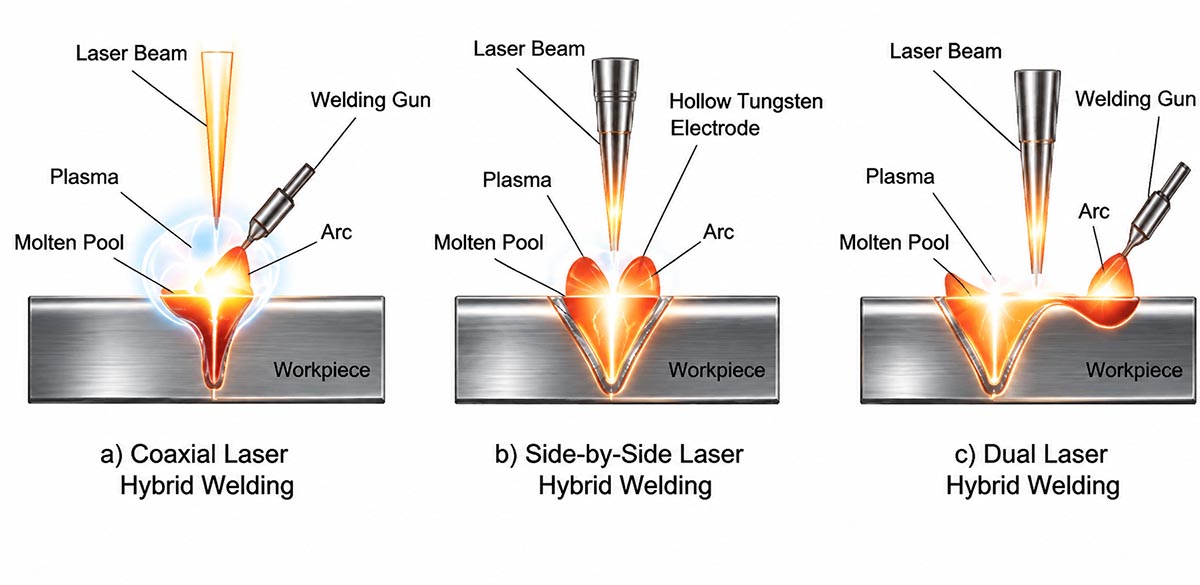
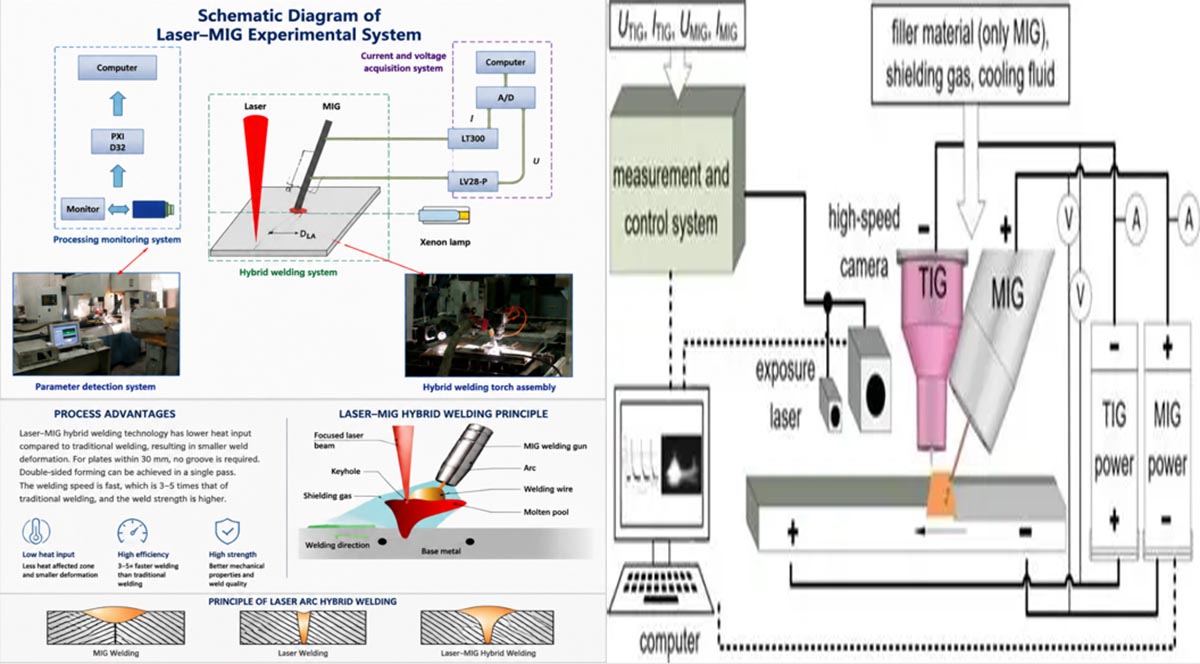
Laser-TIG hybrid welding is a hybrid heat source welding technology that combines laser beam with tungsten arc welding (TIG). This method gives full play to the advantages of high energy density of laser welding and stable forming of TIG welding, and can significantly improve magnesium alloy welding efficiency and joint performance.
Main features:
Laser and arc work together to improve energy utilization;
The welding speed is fast, about 2 times that of traditional TIG welding;
Lower heat input reduces welding distortion;
The burning loss of tungsten electrode is reduced and the service life of the electrode is improved;
The weld width is close to that of laser welding and has good forming quality.
Advantages of hybrid welding:
The plasma generated by the laser can improve arc stability, and at the same time, the arc enters the small hole area formed by the laser, reducing energy loss and achieving more efficient heat source utilization.
Welding performance:
Using reasonable process parameters for laser-TIG hybrid welding, high-quality magnesium alloy welded joints can be obtained, which:
The tensile strength is close to the base material;
Fatigue strength and impact toughness are significantly improved;
The overall performance of the joint is better than traditional TIG welding.
9. Magnesium alloy resistance spot welding (Resistance Spot Welding)
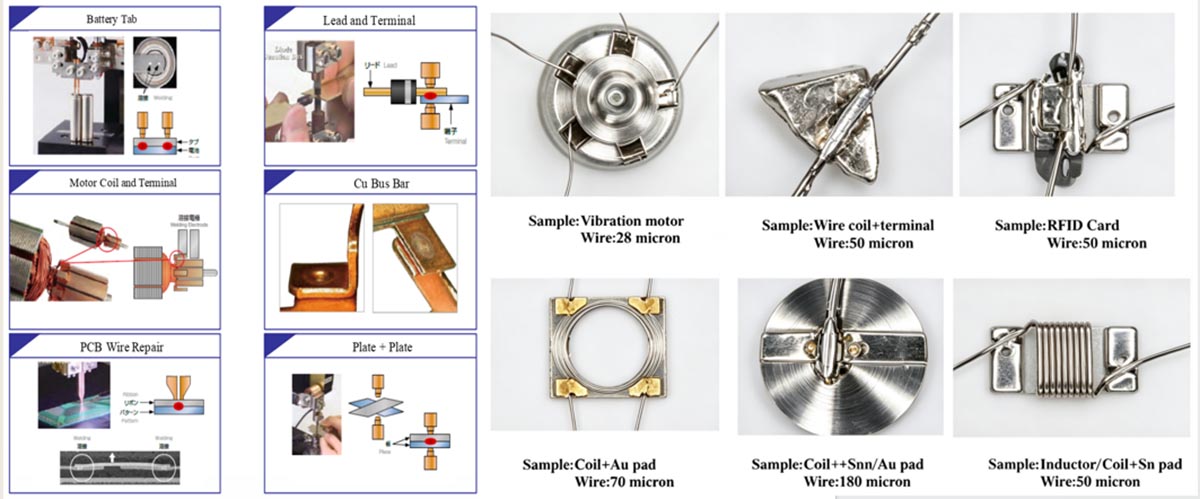
Magnesium alloy resistance welding mainly includes spot welding, seam welding and flash butt welding, among which resistance spot welding is the most widely used. Mg-Al series and Mg-Zn series magnesium alloys have good resistance welding properties and are often used for connecting low-load structural parts.
Application areas:
Resistance spot welding is mainly used for:
Magnesium alloy frame;
Instrument cabin structure;
Partitions and thin-walled components;
Other lightweight magnesium alloy parts.
Process features:
Rapid heating requirements are high
Magnesium alloy has good electrical and thermal conductivity. During welding, a large welding current needs to be passed through in a short time to achieve rapid melting and form a weld nugget.
prone to splashing
An oxide film is easily formed on the surface of magnesium, which increases the contact resistance and causes splashing of molten droplets under the action of large current. Welding parameters need to be reasonably controlled.
prone to defects
Because magnesium alloys have fast thermal conductivity and large linear expansion coefficients, the molten nugget cools and shrinks quickly after a power outage, and it is easy to produce welding defects such as shrinkage cavities and cracks.
Welding equipment:
Both DC pulse spot welding machines and ordinary AC spot welding machines can be used for magnesium alloy spot welding. The key is that the equipment power can meet the instantaneous and rapid heating requirements.
10. Friction Welding of Magnesium Alloys
Friction welding of magnesium alloys is a solid-state joining technology, particularly suitable for materials such as die-cast magnesium alloys that are difficult to join using traditional fusion welding. Because die-cast magnesium alloys often contain micropores, these pores easily enlarge due to heat during fusion welding, reducing joint performance. Therefore, friction welding has become an important research direction for magnesium alloy joining.
Friction Stir Welding Principle:
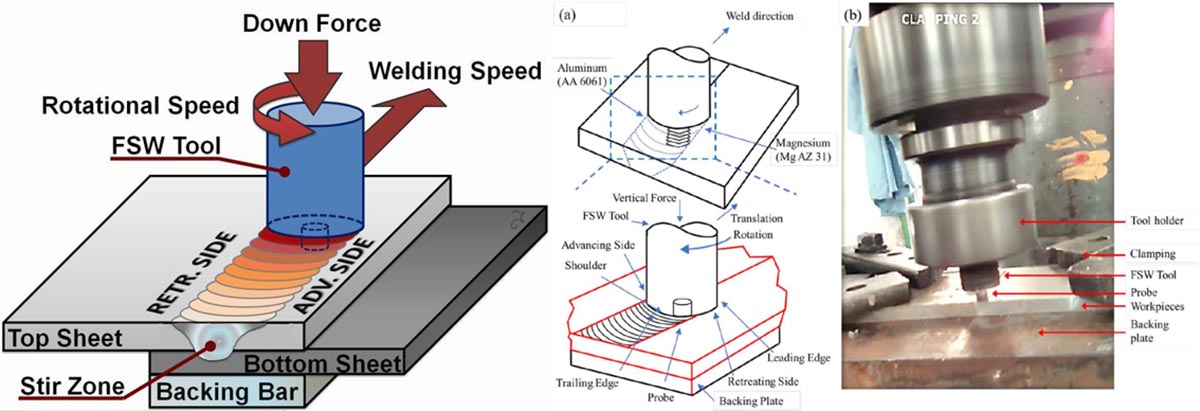
Friction stir welding (FSW) utilizes the friction between a high-speed rotating stirring head and the workpiece to generate heat, bringing the material to a plastic state, and achieving solid-state joining through stirring and extrusion.
Main Characteristics:
* Solid-state welding, no melting process;
* Low welding temperature, reducing defects such as porosity and cracks;
* Minimal joint deformation, good surface finish;
* No significant weld buildup, smooth upper and lower surfaces;
* Suitable for joining low-melting-point metals such as magnesium and aluminum.
Welding Performance:
Friction stir welding can successfully join various magnesium alloys, including:
* AZ61A magnesium alloy
* AM60 magnesium alloy
* Joining dissimilar materials such as magnesium alloys and aluminum alloys
The welded joint typically has:
* No cracks;
* No porosity;
* No incomplete penetration defects;
* Good mechanical properties and stability.
11. Magnesium Alloy Brazing
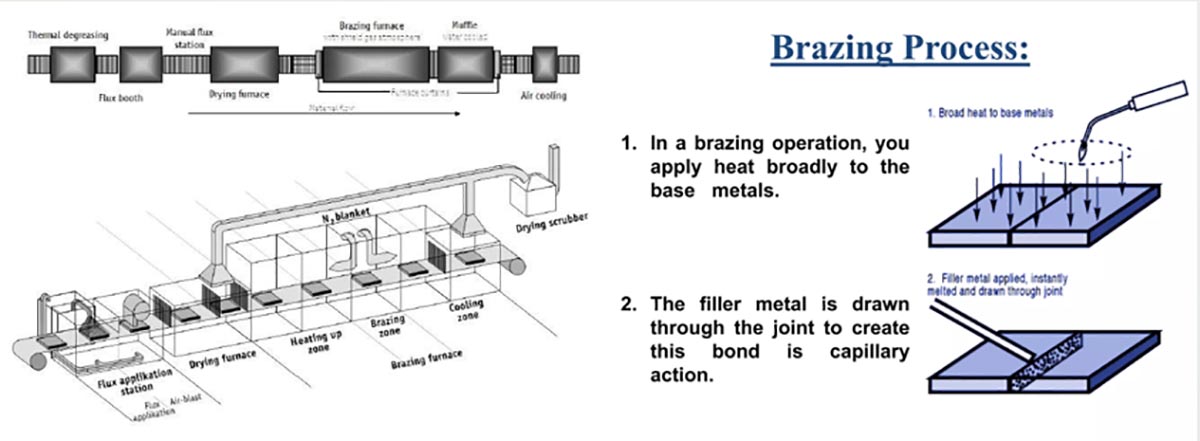
The brazing process for magnesium alloys is similar to that for aluminum alloys, mainly including flame brazing, furnace brazing, and dip brazing methods, with dip brazing being the most widely used.
Process Characteristics:
Magnesium-based brazing filler metals, such as Mg-Al-Zn series filler metals, are commonly used.
The matching flux is usually a mixture of chloride and fluoride powders.
Suitable for joining and partially repairing magnesium alloy parts.
Brazing Methods:
Hard Brazing
Currently, uncoated magnesium alloys mainly use hard brazing. Due to the difficulty in removing the oxide film on the magnesium alloy surface, suitable soft fluxes for removing the oxide film and activating the interface are lacking.
Soft Brazing
The application range of fluxless soft brazing for uncoated magnesium alloys is limited, mainly used for:
Corner joint connections;
Repair of deformed parts;
Filling non-critical surface defects before casting coating.
For magnesium alloys with coatings, conventional soft brazing methods can be used for joining.
III. Prospects for Magnesium Alloy Welding Technology Development
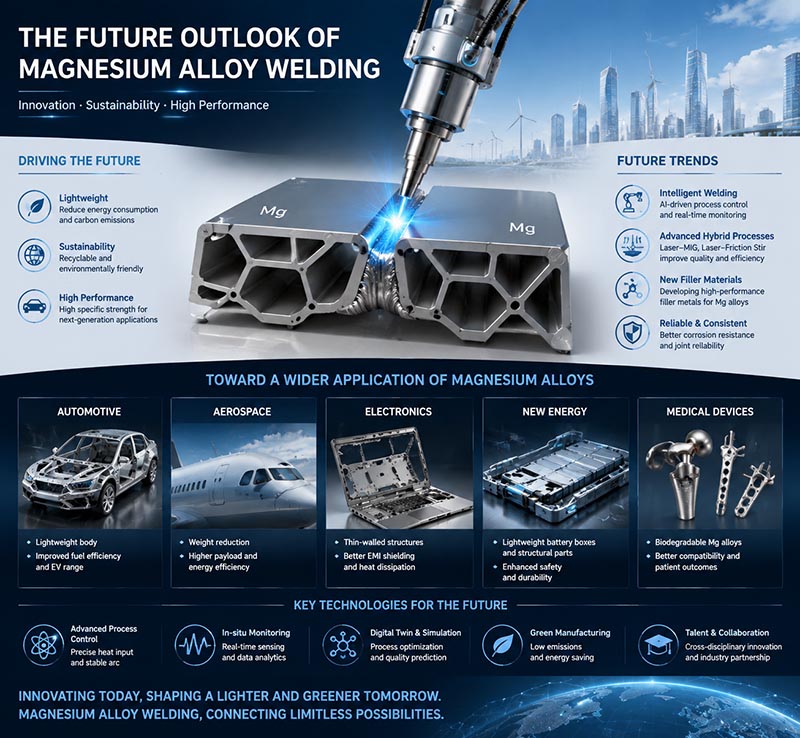 With the accelerating trend of lightweighting through magnesium replacing aluminum, the demand for magnesium alloy welding technology continues to grow in fields such as new energy vehicles, aerospace, and two-wheeled vehicles. Especially with the increasing application of large integrated magnesium alloy structural components, future magnesium alloy welding technology will mainly develop in three directions: solid-state welding, intelligent welding, and material specialization, achieving more efficient and reliable manufacturing.
1. Popularization of Solid-State Welding Technology
Friction stir welding, friction welding, and other non-fusion welding processes can fundamentally reduce traditional welding defects such as porosity and cracks, while also offering advantages such as high joint strength and minimal welding deformation. In the future, this type of technology will be more widely used in the manufacturing of new energy vehicles, rail transportation, and large magnesium alloy structural components, gradually becoming an important method for magnesium alloy joining.
2. Development of Intelligent Welding Technology
Advanced welding technologies such as laser welding and MIG welding will be further integrated with industrial robots, visual inspection, and intelligent control systems to achieve automatic monitoring and adaptive adjustment of welding parameters, including optimization of parameters such as welding current, speed, and shielding gas flow. Intelligent welding can effectively improve welding quality and production efficiency, reduce the difficulty of manual operation, and is more suitable for large-scale automated production.
3. Continuous Upgrading of Specialized Welding Materials
For new materials such as flame-retardant magnesium alloys and high-strength, high-toughness magnesium alloys, specialized welding wires and brazing filler metals will continue to be developed and applied on a large scale. For example, the application range of WE-33M magnesium alloy welding wire will be further expanded. Simultaneously, flux-free soft soldering technology will continue to make breakthroughs, solving the problem of difficult oxide film treatment during the brazing of uncoated magnesium alloys, thus meeting the needs of more high-end manufacturing fields.
Furthermore, for semi-solid formed magnesium alloy parts, the supporting welding processes are also being continuously optimized to improve the compatibility between the formed parts and the welding process, reduce welding defects, and promote the development of magnesium alloys from single component applications to applications in complete vehicles and large structural parts, further releasing the advantages of magnesium alloys in the field of lightweighting.
IV. Conclusion
The core challenge in magnesium alloy welding lies essentially in matching the material properties with the welding process. Due to the low melting point, strong oxidizing properties, and large coefficient of thermal expansion of magnesium alloys, defects such as porosity, hot cracking, and deformation are prone to occur during welding. However, through proper process control, weld quality can be effectively improved.
In actual production, three key aspects should be emphasized:
1. Thorough pre-welding cleaning to remove surface oxide films and contaminants;
2. Appropriate selection of filler materials to ensure the weld composition matches the base metal;
3. Optimization of welding parameters, controlling key factors such as heat input, current, and welding speed to reduce the defect rate and improve product yield.
The ten major magnesium alloy welding processes each have their own characteristics. In practical applications, a reasonable selection should be made based on the material type, part thickness, structural characteristics, and operating environment, rather than blindly pursuing advanced processes. For example: Thin-walled precision parts: suitable for TIG welding and plasma arc welding; Large structural components: suitable for friction stir welding and laser welding; Batch production of thin-plate parts: suitable for resistance spot welding; High-precision complex components: suitable for electron beam welding; Dissimilar material joining: suitable for brazing.
As an important representative of lightweight materials, magnesium alloys are finding increasingly wider applications. In the future, with the development of intelligent welding technology, advanced material systems, and automated manufacturing processes, traditional challenges in magnesium alloy welding will be gradually resolved, and welding efficiency and reliability will continue to improve.
For magnesium alloy processing companies, mastering the characteristics of different welding processes and optimizing processes based on actual product needs will help improve production efficiency, reduce manufacturing costs, and promote the wider application of magnesium alloys in new energy vehicles, aerospace, and high-end equipment.


