



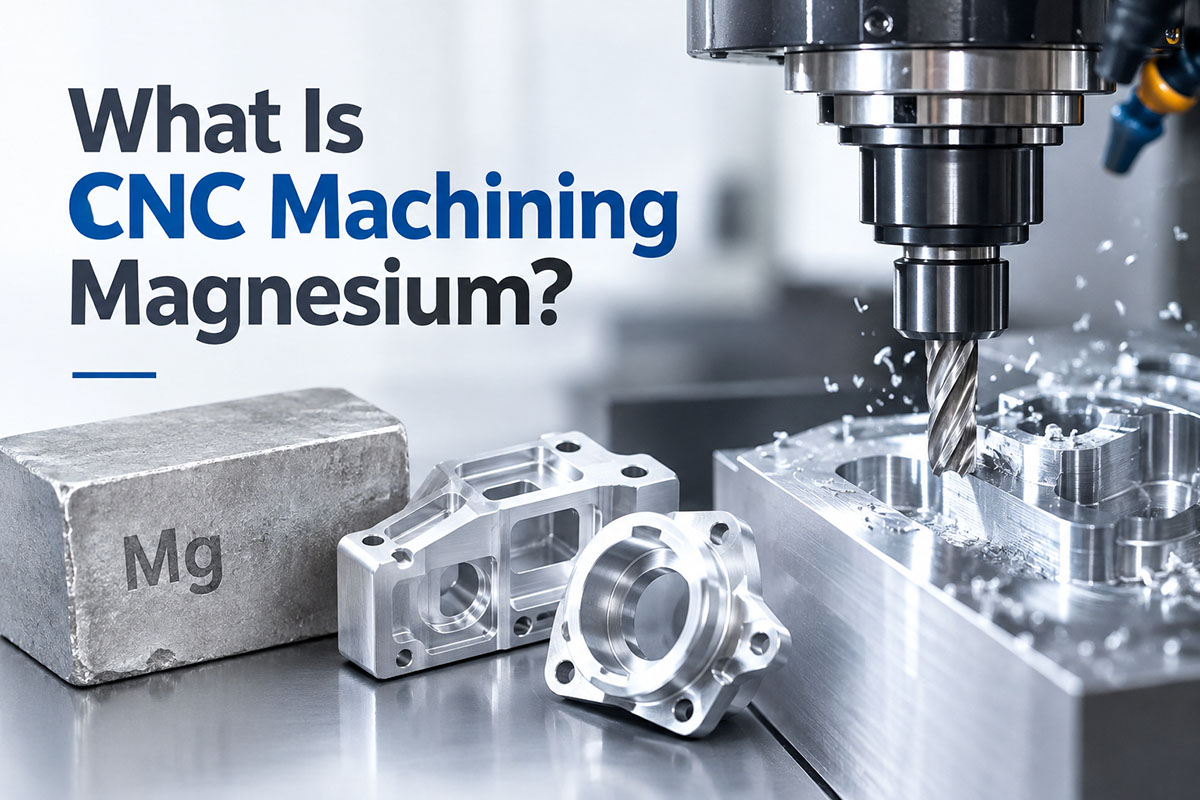
CNC machining magnesium is a precision manufacturing process that uses computer-controlled cutting tools to transform magnesium and magnesium alloys into complex mechanical components. The process includes CNC milling, turning, drilling, tapping, and multi-axis machining to produce lightweight parts with controlled dimensions and surface finishes.
Magnesium alloys are widely recognized for their low density, excellent machinability, and favorable strength-to-weight ratio. These characteristics make them suitable for aerospace, automotive, electronics, robotics, and industrial equipment applications.
However, machining magnesium requires more than conventional CNC equipment. Manufacturers must carefully control cutting conditions, chip management, workholding, and fire safety to ensure reliable production.
This guide explains how magnesium CNC machining works, the most commonly used alloys, machining methods, manufacturing challenges, and considerations for producing custom magnesium parts.
1. Why Is Magnesium Suitable for CNC Machining?
Magnesium is one of the lightest structural metals used in industrial manufacturing. Compared with steel, titanium, and many aluminum alloys, magnesium offers significant weight-saving advantages.
Its relatively low cutting resistance also makes it suitable for efficient CNC machining operations.
Lightweight Material Properties
Magnesium alloys typically have a density of approximately 1.74–1.85 g/cm³, making them around 30–35% lighter than common aluminum alloys by volume.
This characteristic is particularly valuable for manufacturing components where weight reduction is essential.
Examples include aircraft brackets, automotive housings, electronic enclosures, and lightweight robotic components.
Excellent Machinability
One of the major advantages of Magnesium Alloy Machining is its favorable cutting performance.
Compared with many steels and titanium alloys, magnesium generally requires lower cutting forces and can support efficient material removal when suitable machining parameters are applied.
This can provide several manufacturing benefits:
Reduced cutting resistance
Efficient material removal
Lower mechanical loading on cutting tools
Good potential for high-quality machined surfaces
Efficient production of complex geometries
Good Dimensional Machining Capability
CNC machining allows manufacturers to create detailed magnesium alloy components with controlled dimensions.
With suitable equipment, cutting strategies, and inspection procedures, manufacturers can produce parts with complex pockets, mounting holes, threads, and precision mating surfaces.
However, achievable tolerances depend on the component geometry, alloy grade, material condition, and manufacturing process.
2. Common Magnesium Alloys Used in CNC Machining
Different magnesium alloy grades provide different combinations of strength, corrosion resistance, ductility, and machining performance.
Selecting the appropriate alloy is one of the most important steps in custom Magnesium Machining.
Magnesium Alloy | Main Characteristics | Typical Applications |
|---|---|---|
AZ31B | Good formability and machinability | Precision housings, brackets, structural parts |
AZ91D | Excellent castability and good general-purpose properties | Die-cast housings and automotive parts |
AM60B | Good ductility and impact resistance | Automotive structural components |
ZK60A | Relatively high strength in suitable wrought conditions | Aerospace and mechanical components |
WE43 | Useful elevated-temperature performance | Aerospace and specialized engineering parts |
AZ31B Magnesium Alloy Machining
AZ31B is commonly available in wrought forms such as plates, sheets, and extrusions.
It offers a useful combination of lightweight properties, moderate strength, and machinability.
CNC machining AZ31B is suitable for producing precision brackets, equipment housings, and lightweight mechanical structures.
AZ91D Magnesium Alloy Machining
AZ91D is a widely used die-casting magnesium alloy.
It is commonly machined after casting to produce accurate mounting holes, threads, sealing surfaces, and assembly features.
Because AZ91D is primarily associated with casting applications, manufacturers should confirm the material form and specification before selecting it for a project.
ZK60A Magnesium Alloy Machining
ZK60A is a magnesium-zinc-zirconium alloy that can provide relatively high mechanical strength in suitable wrought and heat-treated conditions.
It is considered for lightweight structural components where strength is important.
For precision CNC machining, cutting strategies and workholding should be selected according to the material condition and component geometry.
3. How Does CNC Machining Magnesium Work?
The magnesium CNC machining process typically involves several stages, from material selection and programming to machining, finishing, and quality inspection.
Step 1: Material Selection and Engineering Review
The manufacturing process begins with reviewing technical drawings, 3D CAD models, and component specifications.
Engineers evaluate the required magnesium alloy grade, dimensions, tolerances, surface finish, and production quantity.
Material selection should also consider mechanical loads, operating temperature, corrosion exposure, and assembly requirements.
Step 2: CNC Programming and Process Planning
After confirming the design, engineers develop CNC machining programs using CAD/CAM software.
The machining plan determines:
Cutting tool selection
Spindle speed and feed rate
Cutting depth and toolpath strategy
Workholding and fixture design
Chip collection and fire safety requirements
Inspection procedures
The goal is to achieve consistent machining performance while maintaining component quality and operational safety.
Step 3: CNC Milling, Turning, and Drilling
The magnesium alloy workpiece is secured in the CNC machine and processed according to the programmed toolpaths.
Depending on the component design, the process may involve CNC milling, turning, drilling, tapping, or multi-axis machining.
For complex parts, multiple machining setups may be necessary to access different surfaces and features.
Step 4: Deburring and Surface Finishing
After machining, components undergo deburring and cleaning to remove sharp edges and residual chips.
Depending on application requirements, additional surface treatments may include conversion coatings, micro-arc oxidation, painting, or suitable plating processes.
These treatments can improve corrosion resistance, surface durability, and appearance.
Step 5: Quality Inspection
Finished magnesium CNC parts are inspected against the agreed technical specifications.
Inspection may include dimensional measurement, surface finish evaluation, thread inspection, and verification of critical geometric features.
Appropriate measuring equipment may include coordinate measuring machines, calipers, micrometers, and surface roughness instruments.
4. Common CNC Machining Processes for Magnesium Alloys
Several CNC machining methods are used to manufacture precision magnesium alloy components.
4.1 CNC Milling Magnesium
CNC milling magnesium is one of the most common methods for producing complex mechanical components.
The process uses rotating cutting tools to remove material from a stationary or repositioned magnesium alloy workpiece.
Typical milling operations include face milling, pocket milling, slot milling, contour milling, and drilling.
CNC milling is suitable for:
Magnesium alloy housings
Lightweight structural brackets
Electronic enclosures
Precision mounting components
Complex mechanical parts
For thin-walled components, manufacturers must carefully control cutting forces and clamping pressure to reduce the risk of distortion.
4.2 CNC Turning Magnesium
CNC turning is used to manufacture cylindrical or rotationally symmetrical magnesium alloy components.
During turning, the workpiece rotates while the cutting tool removes material to create the required geometry.
Typical components include shafts, bushings, spacers, sleeves, and circular mounting parts.
Magnesium's favorable machinability can support efficient turning operations, provided that chip formation and cutting conditions are properly managed.
4.3 CNC Drilling and Tapping Magnesium
Drilling and tapping are commonly used to produce holes and threaded connections in magnesium alloy components.
Because magnesium alloys have relatively low hardness compared with many engineering steels, drilling operations can be efficient.
However, thread strength, engagement length, and repeated assembly requirements should be evaluated during component design.
For applications involving frequent fastening, threaded inserts may be considered to improve joint durability.
4.4 5-Axis CNC Machining Magnesium
Five-axis CNC machining enables cutting tools to approach a workpiece from multiple directions.
This is particularly useful for complex magnesium alloy components with angled surfaces, intricate contours, and multiple machining features.
Compared with conventional three-axis machining, five-axis processing can reduce the number of setups for suitable parts and improve access to complex geometries.
It is commonly considered for aerospace components, precision equipment, and advanced mechanical assemblies.
5. Advantages of CNC Machining Magnesium
CNC machining offers several manufacturing advantages when processing magnesium alloys.
Advantage | Manufacturing Benefit |
|---|---|
Excellent machinability | Efficient material removal with suitable tooling |
Low material density | Lightweight finished components |
Complex geometry capability | Manufacture of intricate structural features |
Precision machining | Controlled dimensions and mating surfaces |
Flexible production | Suitable for prototypes and different batch quantities |
Surface finishing compatibility | Multiple protective coating options |
Design flexibility | Easier modification of CNC programs during development |
Efficient Material Removal
Magnesium alloys generally require lower cutting forces than many steels and titanium alloys.
With appropriate machining parameters and safety systems, this can support efficient production.
Complex Component Manufacturing
CNC machining allows engineers to manufacture magnesium components with intricate geometries that may be difficult to produce directly through conventional forming processes.
This is especially valuable for custom magnesium alloy parts requiring multiple mounting features, cavities, and precision surfaces.
Prototype and Production Flexibility
CNC machining can be used for prototype development, small-batch manufacturing, and selected production applications.
This flexibility allows manufacturers to support product development, design verification, and ongoing component supply.
6. Challenges in Magnesium CNC Machining
Although magnesium alloys are relatively easy to cut, they present several manufacturing challenges that require specialized process planning.
6.1 Magnesium Chip and Dust Fire Hazards
Magnesium is a combustible metal under certain conditions.
Fine magnesium chips and dust can ignite when exposed to sufficient heat or ignition sources.
Therefore, magnesium machining requires appropriate chip collection, housekeeping, fire prevention, and emergency response procedures.
Manufacturers must use suitable cutting conditions and ensure that fire protection equipment is appropriate for magnesium fires.
Ordinary water-based firefighting methods must not be used on burning magnesium.
6.2 Thin-Wall Deformation
Magnesium alloys have a lower elastic modulus than aluminum alloys and steel.
Thin-walled magnesium components may deform under excessive clamping pressure or cutting loads.
To reduce deformation, manufacturers should optimize fixture design, toolpaths, cutting forces, and machining sequences.
6.3 Corrosion and Surface Protection
Magnesium alloys can be susceptible to corrosion in certain environments, especially when exposed to chloride-containing moisture or galvanic contact with dissimilar metals.
Protective surface treatments may be necessary to improve service life.
The coating process must be selected according to material grade, component geometry, and operating conditions.
6.4 Dimensional Stability
Thermal expansion, residual stress, and material condition can affect the dimensional stability of magnesium components.
For precision machining, manufacturers should consider temperature control, machining sequence, and inspection conditions.
7. Magnesium CNC Machining vs. Aluminum CNC Machining
Both magnesium and aluminum alloys are widely used for lightweight precision components.
However, their material properties and machining requirements differ.
Comparison | Magnesium Alloy | Aluminum Alloy |
|---|---|---|
Density | Approx. 1.74–1.85 g/cm³ | Approx. 2.65–2.80 g/cm³ |
Weight | Lower | Higher |
Machinability | Generally excellent | Generally excellent |
Elastic Modulus | Approx. 40–45 GPa | Approx. 69–72 GPa |
Corrosion Resistance | Often requires protective measures | Often better in common environments |
Chip Fire Risk | Requires magnesium-specific precautions | Fine particles also require controls |
Typical Applications | Lightweight housings, brackets, structures | Structural parts, housings, industrial components |
Magnesium alloys offer advantages where component weight reduction is a major priority.
Aluminum alloys may be preferred when higher stiffness, broader material availability, or different corrosion performance is required.
The most suitable material depends on the application rather than machining performance alone.
8. Applications of CNC Machined Magnesium Parts
The combination of low density, favorable machinability, and useful mechanical properties makes magnesium alloys suitable for various precision manufacturing applications.
Aerospace Components
Magnesium alloys may be used in selected aerospace brackets, housings, and lightweight equipment structures where the material meets applicable qualification and service requirements.
CNC machining enables the production of detailed geometries and controlled mounting features.
Automotive Components
Magnesium alloys are used in automotive lightweighting applications, including selected housings, structural components, and equipment assemblies.
Precision machining is often required to create mounting holes, threads, and accurate mating surfaces.
Electronic Equipment
Magnesium alloys are suitable for selected electronic housings and portable equipment components.
Their low density and electromagnetic shielding potential make them attractive for lightweight electronic product designs.
Robotics and Industrial Automation
Precision magnesium alloy parts can be used in robotic systems, automation equipment, and lightweight mechanical assemblies.
Reducing moving mass can be beneficial for certain motion-control applications, provided that stiffness and strength requirements are satisfied.
9. Custom Magnesium CNC Machining Services
For companies developing lightweight mechanical components, custom magnesium machining services provide a flexible solution for transforming engineering designs into finished parts.
An experienced magnesium alloy machining manufacturer should evaluate the complete manufacturing process, including material selection, machining feasibility, surface finishing, and quality inspection.
Custom Magnesium Alloy Parts Manufacturing
Custom machining services may include:
CNC milling and turning
Multi-axis machining
Precision drilling and tapping
Prototype machining
Small-batch and production manufacturing
Deburring and surface finishing
Dimensional inspection
Design for Manufacturability
Design for Manufacturability (DFM) helps identify potential production challenges before machining begins.
For magnesium alloy components, DFM considerations may include wall thickness, corner radii, machining accessibility, thread design, material selection, and workholding.
Early engineering review can help reduce unnecessary machining complexity and improve manufacturing efficiency.
Request a Custom Magnesium Machining Quote
When requesting a quotation for custom magnesium CNC parts, customers should provide technical drawings or 3D models, material grades, quantities, tolerance requirements, surface finishing specifications, and expected delivery schedules.
Clear technical information helps manufacturers evaluate feasibility, select appropriate processes, and prepare accurate quotations.
10. Frequently Asked Questions About CNC Machining Magnesium
Is magnesium easy to CNC machine?
Yes. Magnesium alloys generally have excellent machinability and relatively low cutting resistance. However, safe machining requires appropriate cutting strategies, chip management, and fire prevention measures.
What magnesium alloys are commonly used for CNC machining?
Commonly considered grades include AZ31B, AZ91D, ZK60A, and WE43. The appropriate material depends on mechanical requirements, material form, availability, and application conditions.
Can magnesium be machined with conventional CNC machines?
Suitable conventional CNC machines can be used to machine magnesium alloys, but the operation requires magnesium-compatible chip management, machining procedures, and fire safety systems.
Is magnesium CNC machining expensive?
The cost depends on material grade, component complexity, machining time, production quantity, and finishing requirements. Magnesium's favorable machinability can reduce certain cutting costs, but material procurement and safety requirements also affect the total cost.
Can magnesium alloys be CNC milled and turned?
Yes. Magnesium alloys can be processed using CNC milling, turning, drilling, tapping, and multi-axis machining methods.
What surface finishes are available for magnesium CNC parts?
Available options may include chemical conversion coatings, micro-arc oxidation, painting, and suitable plating processes. The finishing method should be selected according to corrosion, wear, appearance, and dimensional requirements.
What tolerances can CNC machined magnesium parts achieve?
Achievable tolerances depend on part size, geometry, material condition, machining equipment, and inspection requirements. Precision tolerances should be evaluated individually rather than assumed for every component.
How do I choose a magnesium CNC machining manufacturer?
Consider the manufacturer's magnesium processing experience, fire safety procedures, equipment capability, material sourcing, inspection methods, and ability to meet the project's technical specifications.
CNC machining magnesium is an effective manufacturing method for producing lightweight, complex, and precision-engineered components.
Magnesium alloys offer excellent machinability, low density, and useful mechanical characteristics, making them suitable for aerospace, automotive, electronics, and industrial equipment applications.
However, successful magnesium alloy machining requires appropriate material selection, machining strategies, chip management, surface protection, and quality control.
For OEM projects and custom component manufacturing, working with a qualified magnesium CNC machining manufacturer can help transform technical designs into reliable finished parts while addressing the material's specific processing requirements.


