



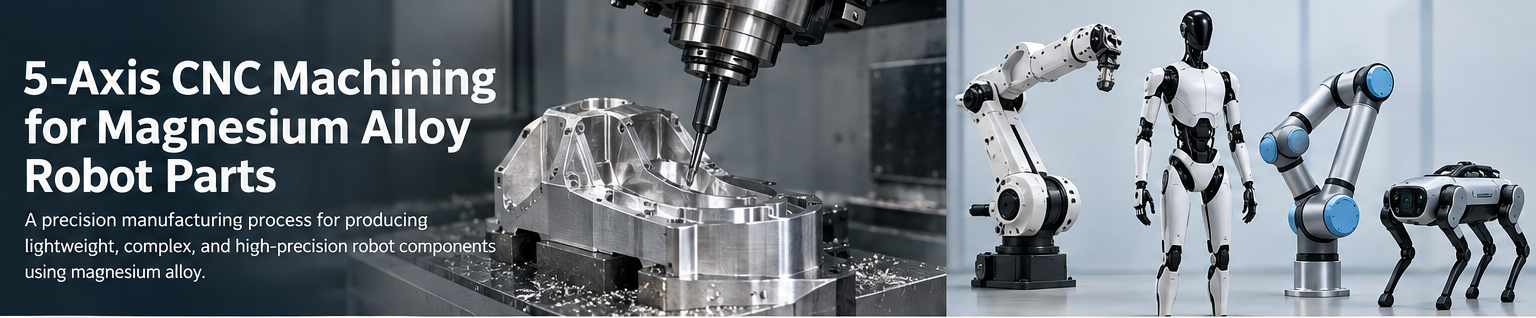
As robotics technology continues to develop, manufacturers are looking for ways to make robotic systems lighter, more precise, and more efficient. Magnesium alloy is a lightweight material that can be considered for selected robot components, while 5-axis CNC Machining provides the flexibility needed to manufacture complex geometries.
So, what is 5-axis CNC machining for magnesium alloy robot parts? It is a precision manufacturing process that uses a five-axis CNC machine to cut magnesium alloy from multiple directions, allowing manufacturers to produce complex robot components with accurate dimensions and detailed features.
This machining method can be used for various applications, including industrial robots, humanoid robots, collaborative robots, and robotic dogs.
What Is 5-Axis CNC Machining?
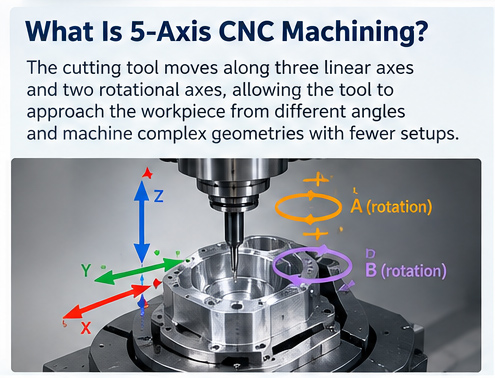
5-axis CNC machining is an advanced manufacturing process that allows a cutting tool to move along three linear axes and two rotational axes. The additional rotational movement allows the tool to approach the workpiece from different angles.
Compared with conventional 3-axis machining, 5-axis CNC machining can access multiple surfaces with fewer setups. This makes it suitable for parts with curved surfaces, angled holes, deep cavities, and complex geometries.
For robot components, these capabilities can be useful because many parts contain multiple mounting surfaces, precision holes, curved structures, and features positioned at different angles.
 Why Use Magnesium Alloy for Robot Components?
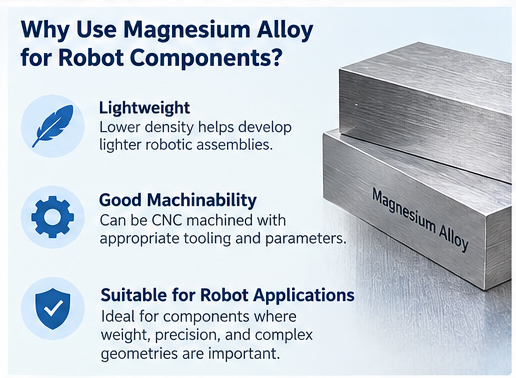
Magnesium alloy has a relatively low density compared with many other structural metals, making it a potential material for applications where component weight is an important consideration.
Lightweight Robot Components
Reducing the weight of individual components can help manufacturers develop lighter robotic assemblies. Depending on the robot design, lightweight parts may also help reduce the load placed on motors and drive systems.
Machinability of Magnesium Alloy
Magnesium alloys can be CNC machined with appropriate tooling and cutting parameters. However, manufacturers need to pay attention to chip removal, heat management, tooling, and safety during the machining process.
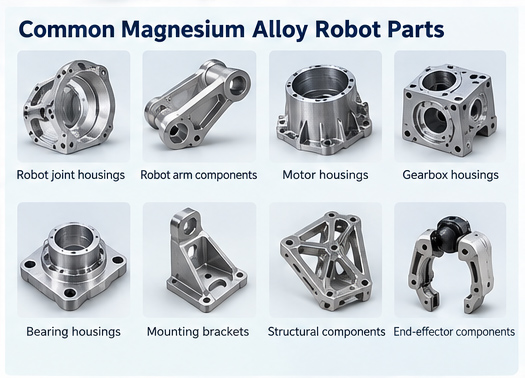
Common magnesium alloy robot parts include:
Robot joint housings
Robot arm components
Motor housings
Gearbox housings
Bearing housings
Mounting brackets
Structural components
End-effector components
 How Are Magnesium Alloy Robot Parts Machined?
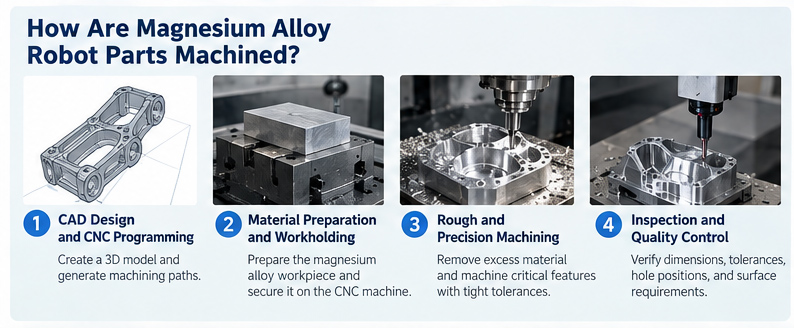
The machining process usually starts with a CAD model or engineering drawing. The model provides the dimensional and geometric information required to program the CNC machine.
CAD Design and CNC Programming
The robot component is designed using CAD software, while CAM software can be used to generate the machining paths.
The CNC program considers the component geometry, tool orientation, machining sequence, workholding method, cutting parameters, and required tolerances.
Material Preparation and Workholding
A suitable magnesium alloy workpiece is prepared according to the component requirements. The workpiece is then securely positioned on the CNC machine.
One advantage of 5-Axis Machining is that multiple surfaces can often be accessed without repeatedly repositioning the workpiece.
Rough and Precision Machining
During rough machining, excess material is removed to create the basic shape of the robot part.
Precision machining then focuses on critical dimensions, holes, mounting surfaces, curved areas, and other features that require tighter control.
Inspection and Quality Control
After machining, the finished robot components are inspected to verify dimensions, tolerances, hole positions, and surface requirements.
Depending on the application, manufacturers may use CMM equipment, precision gauges, or other inspection methods.
Machining of Humanoid Robot Components
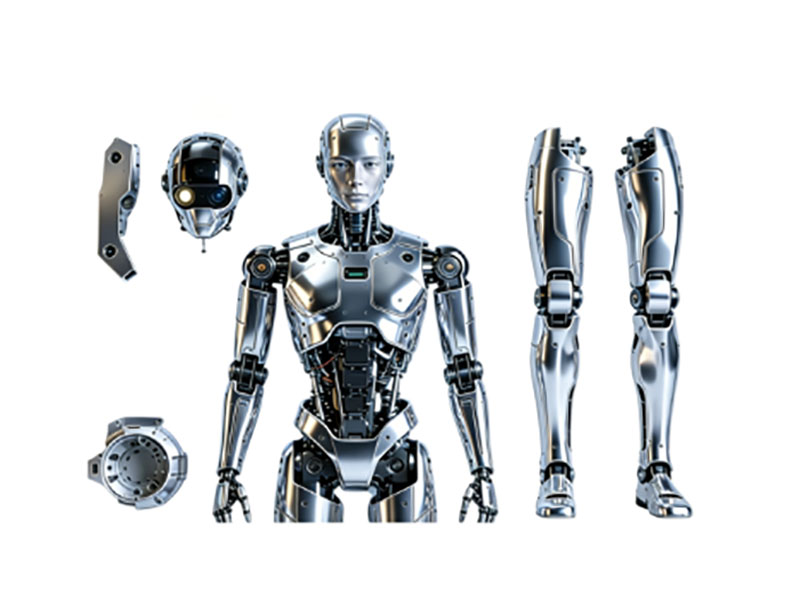
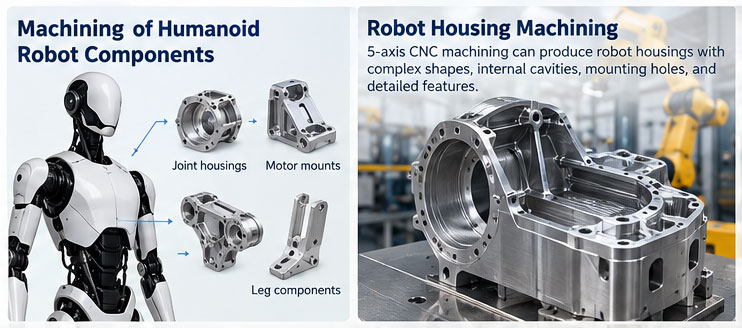
Humanoid robots contain numerous mechanical components designed to reproduce human-like movement. These may include body structures, arm components, leg components, joint housings, motor mounts, and other precision parts.
Humanoid Robot Joint Components
Humanoid robot joint components can include joint housings, bearing seats, motor mounting surfaces, shafts, brackets, and other mechanical parts.
These components often require accurate positioning because multiple parts need to work together as a complete joint assembly. 5-axis CNC machining can provide flexible tool access when manufacturing components with complex shapes and multiple machining surfaces.
Complex Structures for Humanoid Robots
Humanoid robot components may have curved surfaces, internal cavities, mounting holes, and other detailed features.
Using 5-axis CNC machining can reduce the number of workpiece setups required for certain complex parts and provide better access to difficult-to-reach areas.
 Robot Housing Machining
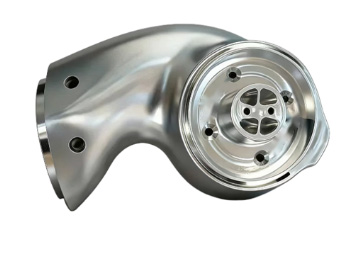
Robot housing machining refers to the CNC machining of housings used to support and protect motors, gears, bearings, sensors, and other components within a robotic system.
A robot housing may include curved external surfaces, internal cavities, bearing bores, mounting holes, and precision interfaces.
Why Is 5-Axis Machining Useful for Robot Housings?
Robot housings can have complex geometries that require machining from several directions. A 5-axis CNC machine can change the cutting tool orientation to reach different areas of the workpiece.
This can help reduce repeated setups and maintain the positional relationship between different machined features.
When magnesium alloy is selected for a robot housing, the machining process also needs to consider the material's specific cutting and chip-management requirements.
 Machining of Robot Joint Components
Robot joints connect different sections of a robotic system and allow controlled movement between them.
Common Robot Joint Parts
CNC machining can be used to produce:
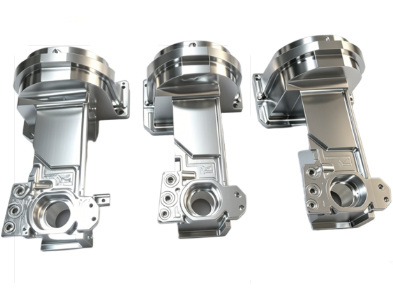
Joint housings
Bearing seats
Motor mounts
Gear interfaces
Shafts
Mounting brackets
Precision structural components
The exact machining requirements depend on the robot's joint design, load conditions, movement range, and assembly structure.
Why Does Accuracy Matter for Robot Joints?
Robot joint components often need to work together with bearings, motors, gears, shafts, and other precision components.
Accurate machining of mounting surfaces, bores, and hole positions can therefore be important for proper assembly and component compatibility.
 Machining of Metal Parts for Robot Dogs
Robotic dogs contain compact mechanical systems that require various precision metal parts. These may include leg joints, motor housings, gear housings, brackets, structural components, and foot components.
CNC Machining for Robotic Dog Components
Machining of metal parts for robot dogs can involve different materials, including aluminum alloys, magnesium alloys, steel, and other engineering metals.
The material is selected according to factors such as mechanical load, weight requirements, wear resistance, operating environment, and component design.
For selected lightweight structural components, magnesium alloy can be considered when its material properties meet the application requirements.
What Are the Benefits of 5-Axis Machining for Robot Parts?
5-axis CNC machining can provide several advantages when manufacturing complex robot components.
Complex Geometry
Robot parts can contain curved surfaces, angled holes, pockets, cavities, and multiple mounting features.
The additional rotational axes allow the cutting tool to approach these features from different directions, making complex geometries easier to machine.
Fewer Machining Setups
Some complex parts require multiple orientations when produced using conventional CNC equipment.
5-axis machining can reduce the number of setups required for certain parts, which can help reduce repositioning work and potential positioning errors.
Accurate Feature Positioning
Robot components often need to connect with motors, bearings, gears, shafts, sensors, and other mechanical parts.
A properly controlled CNC machining process can produce the required dimensions and positional relationships according to engineering specifications.
Suitable for Lightweight Components
When magnesium alloy is selected for a robot component, 5-axis CNC machining can be used to manufacture complex lightweight parts while maintaining the required geometry.
What Robot Components Can Be Made from Magnesium Alloy?
The suitability of magnesium alloy depends on the specific application and engineering requirements.
Robot Joint Housings
Robot joint housings can contain precision bores, mounting surfaces, and interfaces for motors, bearings, and gears.
Robot Arm Components
Robot arm components can have curved structures and multiple mounting features. CNC machining can produce customized parts according to engineering drawings.
Motor and Gearbox Housings
Motor and gearbox housings need accurate mounting and assembly features. 5-axis machining can be useful when these housings have complex geometries.
Mounting Brackets and End-Effectors
Mounting brackets and end-effector components often require multiple holes, angled surfaces, or customized interfaces, making CNC machining suitable for various designs.
Applications of Magnesium Alloy Robot Components
Magnesium alloy CNC machined components can be considered for different robotic and automation applications where lightweight construction and precision manufacturing are important.
Industrial Robots
Industrial robots may use CNC machined components in robotic arms, joints, housings, brackets, and other mechanical assemblies.
Humanoid Robots
Humanoid robots contain multiple joints and structural components. CNC machined metal parts can be used for joint housings, arm structures, motor mounts, brackets, and other mechanical assemblies.
Collaborative Robots
Collaborative robots may use lightweight mechanical components in applications where compact design and reduced component weight are important considerations.
Robotic Dogs
Robotic dogs require precision components for their legs, joints, motors, and structural assemblies. CNC machining can produce customized metal parts according to specific design requirements.
Other potential applications include:
Automated production equipment
Robotic handling systems
Assembly robots
Inspection robots
Material handling systems
Customized automation equipment
Robotic end-effectors
Key Considerations When Machining Magnesium Alloy
Although magnesium alloy can offer good machinability, CNC machining requires appropriate process control.
Chip Management
Magnesium chips and dust require careful handling because finely divided magnesium can present a fire hazard. Proper cutting parameters, chip removal, housekeeping, and safety procedures are therefore important.
Tool Selection and Cutting Parameters
The cutting tool and machining parameters should be selected according to the magnesium alloy, component geometry, required tolerances, and machining operation.
Quality Inspection
For precision robot components, dimensional inspection is important. Critical features such as bearing bores, mounting holes, flatness, and overall dimensions should be checked according to the engineering requirements.
5-axis CNC machining provides a flexible manufacturing method for complex magnesium alloy robot parts. By combining multi-angle machining with the lightweight characteristics of magnesium alloy, manufacturers can produce components such as robot joint housings, arm components, motor housings, gearbox housings, mounting brackets, and end-effector parts.
The same machining capabilities can also be applied to the machining of humanoid robot components, robot housing machining, machining of robot joint components, and machining of metal parts for robot dogs.
For robotic applications, the appropriate material and machining method should be selected according to the component's geometry, mechanical requirements, operating environment, and dimensional specifications.
FAQ
Can Magnesium Alloy Be CNC Machined?
Yes. Magnesium alloys can be CNC machined with appropriate tools, cutting parameters, chip management, and safety procedures.
Why Is Magnesium Alloy Used for Robot Parts?
Magnesium alloy has a relatively low density and can be considered for robot components where reducing component weight is an important design requirement.
What Is 5-Axis CNC Machining?
5-axis CNC machining uses three linear axes and two rotational axes to allow the cutting tool to approach a workpiece from multiple directions.
What Robot Components Can Be Made with CNC Machining?
CNC machining can produce robot joint housings, robot arm components, motor housings, gearbox housings, mounting brackets, bearing housings, end-effectors, and other customized metal parts.
What Is Robot Housing Machining?
Robot housing machining is the CNC machining process used to manufacture housings that support or protect motors, gears, bearings, sensors, and other robotic components.
Can CNC Machining Be Used for Humanoid Robot Components?
Yes. CNC machining can be used to manufacture humanoid robot joint components, structural parts, motor mounts, brackets, housings, and other Precision Metal Components.
What Metal Parts Can Be Machined for Robot Dogs?
CNC machining can be used to manufacture metal parts for robot dogs, including leg joints, motor housings, gear housings, brackets, structural components, and foot components.


