



magnesium alloys are increasingly used in lightweight engineering applications because of their low density, high strength-to-weight ratio, and excellent potential for reducing component weight.
From humanoid robots and drones to 3C electronics, communication equipment, and precision mechanical parts, manufacturers are looking for ways to replace heavier metals without sacrificing structural performance.
However, magnesium alloy also has a major limitation: high chemical activity and poor inherent corrosion resistance.
Traditional magnesium alloy surface treatments such as anodizing, micro-arc oxidation (MAO), painting, and electrophoretic coating can improve corrosion resistance, but they may introduce other problems. Porous oxide layers require additional sealing, organic coatings can increase thermal resistance, and multilayer coating systems can affect weight, dimensional tolerances, and heat dissipation.
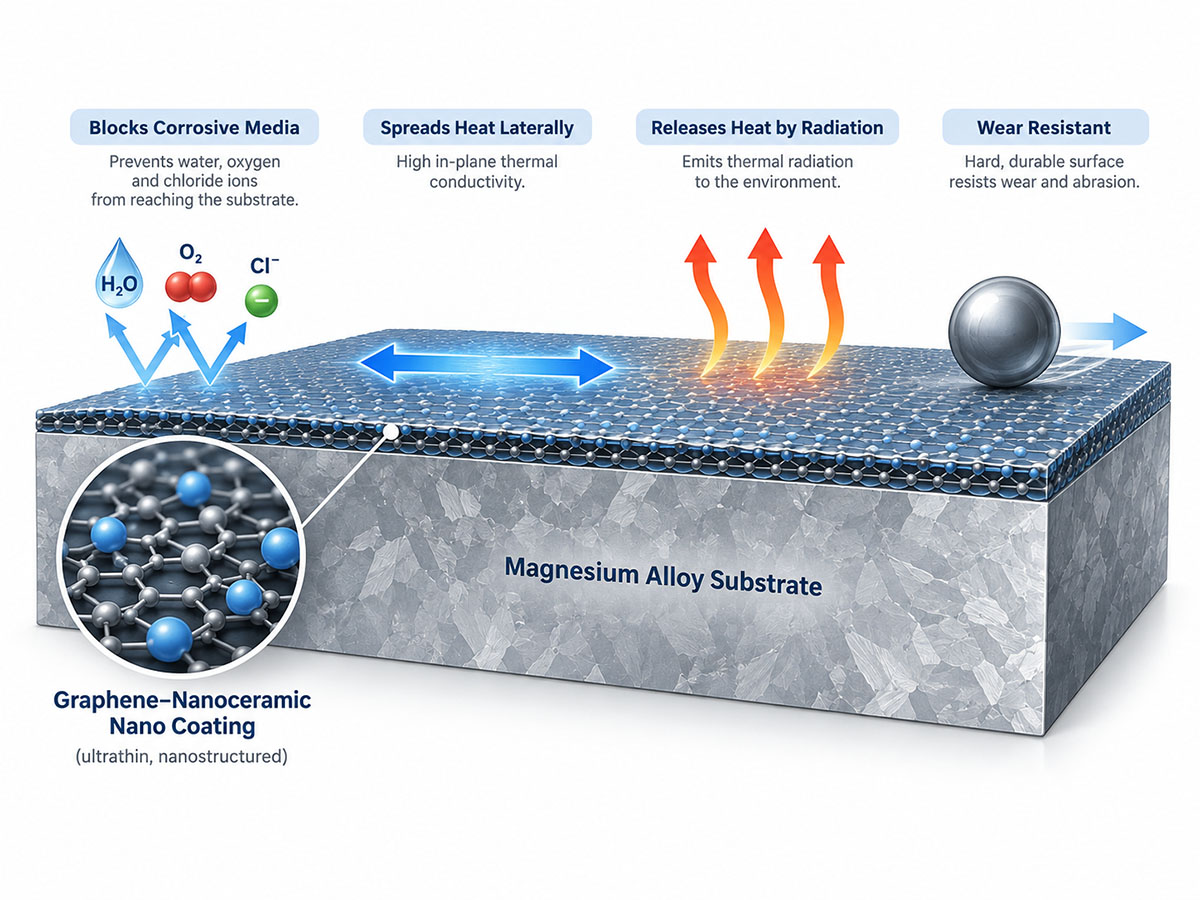
A magnesium alloy nano coating based on graphene and nanoceramic materials provides another surface treatment approach.
By combining graphene with nanoceramic materials such as zirconia, alumina, or silicon carbide, a thin functional coating can be designed to provide corrosion protection, thermal management, wear resistance, and electrical insulation within a single coating system.
 Why Does Magnesium Alloy Need Advanced Surface Treatment?
Magnesium is one of the lightest structural metals used in industrial manufacturing.
Its low density makes magnesium alloys particularly attractive for applications where every gram matters, including:
humanoid robot structures
robot joint housings
UAV and drone components
electronic housings
communication equipment
precision mechanical parts
lightweight thermal management components
Reducing component weight can reduce mechanical load and improve overall system efficiency.
The challenge is that magnesium alloys are highly chemically active.
Exposure to moisture, oxygen, chloride ions, salt spray, or contact with dissimilar metals can accelerate corrosion.
Conventional magnesium alloy surface treatment technologies can provide protection, but each method has limitations.
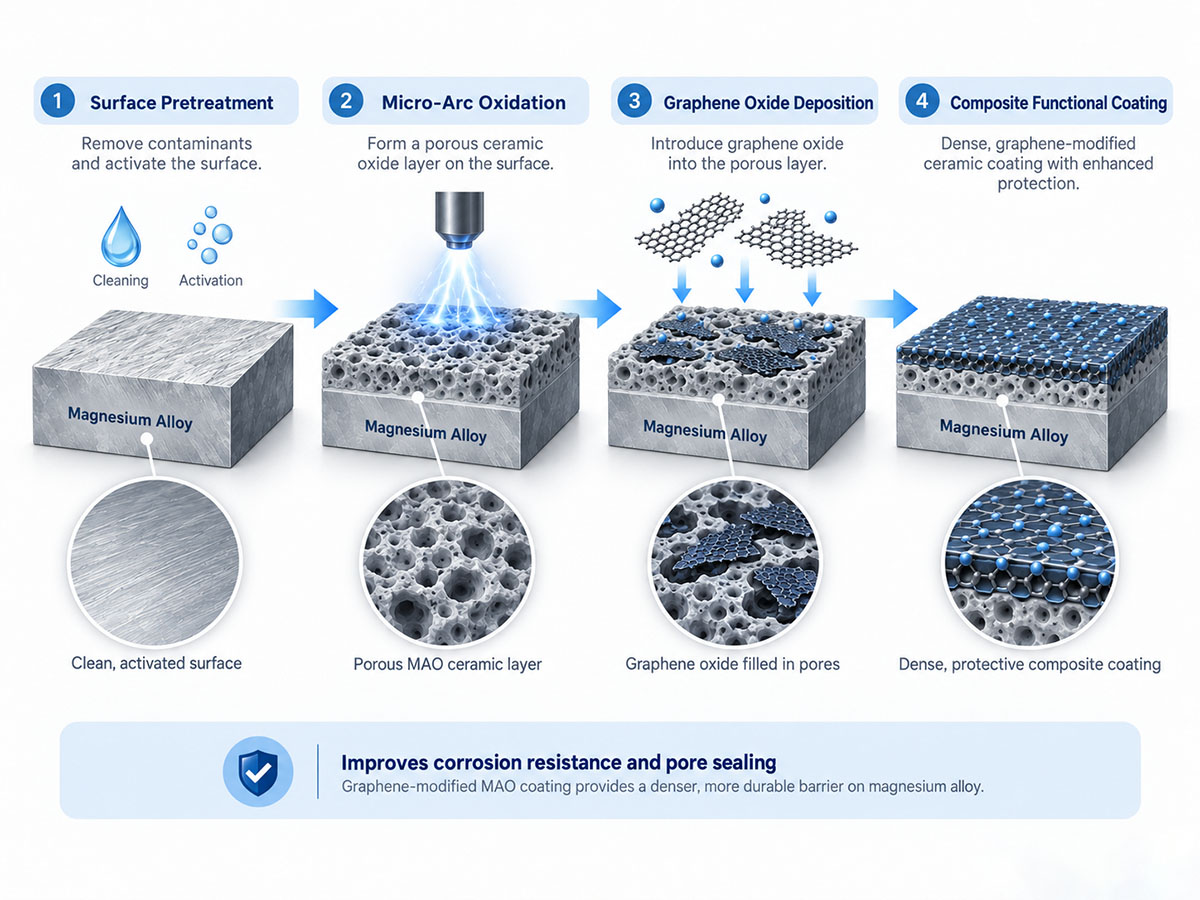
For example, micro-arc oxidation forms a ceramic oxide layer with a naturally porous structure. Additional sealing is therefore often required to improve corrosion resistance.
Paint and electrophoretic coatings can provide environmental protection, but organic coating layers may introduce additional thermal resistance.
Multilayer treatments can also increase total coating thickness and create problems for threaded holes, precision interfaces, microchannels, or other tight-tolerance structures.
Common Surface Treatment Challenges
| Challenge | Effect on Magnesium Alloy Components |
|---|---|
| High chemical activity | Increased risk of corrosion in humid or saline environments |
| Galvanic corrosion | May occur when magnesium contacts dissimilar metals |
| Porous oxide coatings | Often require additional sealing |
| Thick multilayer coatings | Can influence dimensional tolerance |
| Organic coating thermal resistance | May reduce heat dissipation |
| Poor coating compatibility | Can lead to cracking or delamination |
| Complex component geometry | Makes uniform coating more difficult |
These challenges become more serious when a magnesium component must simultaneously provide lightweighting, corrosion resistance, heat dissipation, and dimensional accuracy.
What Is a Graphene–Nanoceramic Magnesium Alloy Nano Coating?
A graphene–nanoceramic magnesium alloy coating is a composite functional surface treatment.
Instead of relying on a conventional multilayer structure in which corrosion protection, insulation, and finishing layers are applied separately, the proposed nano coating combines multiple functional materials into a thin composite film.
The system described in the provided technical material combines:
Graphene + nanoceramic materials
Typical nanoceramic components may include:
zirconium oxide
aluminum oxide
silicon carbide
Graphene and nanoceramics perform different but complementary functions.
Graphene contributes barrier properties, heat transfer capability, and interface bonding.
Nanoceramics contribute hardness, thermal stability, wear resistance, pore filling, and structural reinforcement.
The goal is to form a dense, thin functional layer rather than stacking multiple thick coatings.
Functions of Graphene and Nanoceramics
| Coating Component | Primary Function |
|---|---|
| Graphene | Blocks corrosive media |
| Graphene | Creates thermal conduction paths |
| Graphene | Helps improve interface bonding |
| Graphene | Can influence electrical properties |
| Nanoceramic particles | Improve hardness and wear resistance |
| Nanoceramic particles | Fill pores and coating defects |
| Nanoceramic particles | Improve high-temperature stability |
| Nanoceramic particles | Help control graphene agglomeration |
How Does Graphene Improve Magnesium Alloy Corrosion Resistance?
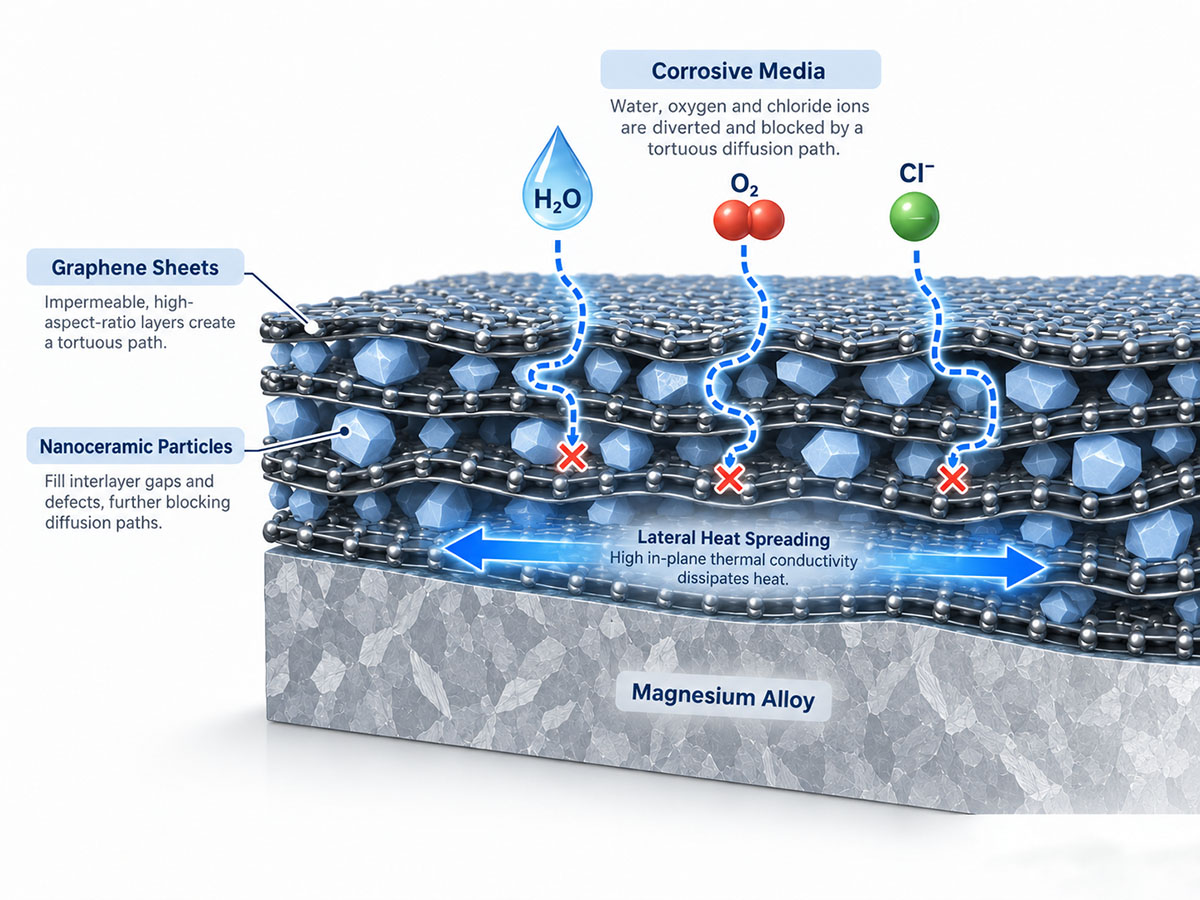
One of the main functions of a graphene coating for magnesium alloy is to reduce penetration of corrosive media.
Graphene consists of two-dimensional sheet-like structures.
When properly dispersed within a coating, these sheets can create a tortuous or “maze-like” path.
Instead of water, oxygen, and chloride ions traveling directly toward the magnesium substrate, they must travel around multiple graphene layers.
This increases the diffusion path and can reduce the rate at which corrosive species reach the underlying metal.
Graphene can also help fill small coating pores and defects.
This is especially relevant for micro-arc oxidation coatings, where the original ceramic layer can contain pores and discharge channels.
According to the supplied technical material, graphene modification can therefore contribute to:
reduced coating porosity
improved barrier protection
reduced corrosion pathways
improved coating density
better resistance to localized corrosion
The material also discusses graphene-based coating strategies for reducing galvanic corrosion risks in magnesium components.
However, graphene must be properly dispersed and engineered into the coating.
Poorly dispersed graphene may agglomerate and create coating defects rather than eliminating them.
Why Combine Graphene with Nanoceramic Materials?
Using graphene alone does not automatically produce an optimized magnesium alloy coating.
The technical material highlights two important challenges.
First, graphene sheets can agglomerate when dispersion is not properly controlled.
Second, graphene is electrically conductive. If the coating design is inappropriate, electrical interactions may increase rather than reduce localized electrochemical corrosion.
For this reason, industrial coating systems generally require careful composite design instead of applying a simple pure graphene film directly to magnesium.
Nanoceramic materials can provide the second functional phase.
Materials such as zirconia and alumina can improve:
coating hardness
wear resistance
thermal stability
pore filling
mechanical reinforcement
graphene dispersion stability
The provided material specifically notes that a second nanoceramic phase can help suppress graphene aggregation and improve overall coating stability.
This is one reason why graphene nanoceramic coating is more relevant to industrial magnesium alloy components than a simple graphene-only coating.
Can Magnesium Alloy Nano Coating Improve Heat Dissipation?
Traditional paint and electrophoretic coatings generally use polymer-based matrices.
These materials may provide corrosion protection but can also increase thermal resistance between the magnesium substrate and the external environment.
For heat-generating components such as:
motor housings
robot joints
electronic enclosures
UAV motor bases
communication housings
this can be undesirable.
Graphene has high in-plane thermal conductivity.
When properly distributed inside a coating, graphene sheets can form thermal conduction pathways and help spread localized heat across the coated surface.
The supplied technical material describes a combined mechanism involving:
thermal conduction + heat spreading + thermal radiation
The coating described in the presentation is also designed as a very thin layer, reducing the amount of additional material between the magnesium substrate and the environment.
Reported Performance Data From the Technical Material
| Parameter | Reported Value |
|---|---|
| Coating thickness | Approximately 2–5 μm |
| Dimensional tolerance | ±3 μm |
| Bonding strength | >8 MPa |
| Horizontal thermal conductivity | ≥800 W/(m·K) |
| Vertical thermal conductivity | ≥20 W/(m·K) |
| Thermal emissivity | Approximately 0.92 |
| Salt spray performance | Up to thousand-hour level depending on system and test conditions |
These figures originate from the supplied technical presentation and should be matched with the actual coating specification, testing standard, substrate, pretreatment condition, and laboratory report before they are used as guaranteed commercial specifications.
Magnesium Alloy Nano Coating vs. Traditional Surface Treatments
Different magnesium alloy surface treatments solve different engineering problems.
There is no single process that is automatically best for every part.
The more useful question is:
What does the magnesium component actually need to achieve?
Surface Treatment Comparison
| Surface Treatment | Corrosion Protection | Heat Dissipation | Typical Thickness* | Process Structure | Best Suited For |
|---|---|---|---|---|---|
| Micro-Arc Oxidation (MAO) | Good, normally requires sealing | Limited after sealing | 10–50 μm | Oxidation + sealing | General corrosion and wear protection |
| Paint / E-Coating | General protection | Relatively poor thermal transfer | 20–80 μm | Often multilayer | General environmental protection |
| Graphene-Modified MAO | Better pore sealing and corrosion resistance | Improvement is limited by MAO structure | Depends on MAO system | MAO + graphene modification | Upgrading existing MAO processes |
| Graphene–Nanoceramic Nano Coating | Designed for high corrosion resistance | Conduction + radiation approach | 2–5 μm | Thin composite functional layer | Lightweight heat-generating precision parts |
*Thickness values are based on the ranges stated in the provided material and can vary according to the actual process.
The comparison shows why magnesium alloy nano coating should not simply be viewed as a replacement for MAO.
For a standard structural component with no major thermal requirement, conventional micro-arc oxidation may still provide excellent cost-performance.
For a precision component that simultaneously requires:
corrosion protection + heat dissipation + low weight + dimensional control
a thin graphene–nanoceramic coating may offer a stronger engineering advantage.
 Four Graphene-Based Surface Treatment Routes for Magnesium Alloy
Graphene can be introduced into magnesium alloy surface treatment through several processes.
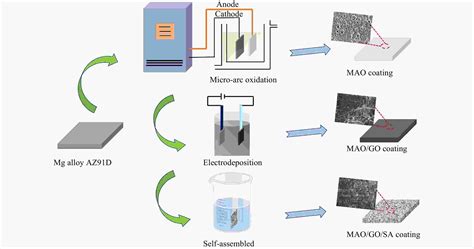
1. Graphene-Modified Micro-Arc Oxidation
Graphene oxide, or GO, can be added to the MAO electrolyte.
During oxide layer formation, graphene-related material becomes incorporated into the ceramic coating.
Its main function is to reduce porosity and block discharge pores.
Advantages
can upgrade an existing MAO production line
improves coating density
can improve corrosion resistance
can improve wear performance
Limitation
The underlying MAO coating remains a ceramic oxide structure, so the fundamental thermal characteristics of the coating are not completely changed.
This route is therefore more suitable for components where corrosion and wear are more important than heat dissipation.
2. Graphene-Modified Organic Coatings
Graphene can also be added to:
epoxy coatings
silane systems
paint
conversion coatings
Graphene improves the barrier properties of the coating and may extend corrosion protection.
However, the polymer matrix remains relatively thermally insulating.
As a result, this route is generally more suitable for:
corrosion protection and antistatic applications
rather than high-performance thermal management.
3. Electrophoretic, Spin-Coated, or Composite Graphene Films
Graphene and graphene oxide films can also be prepared through electrophoretic deposition, spin coating, or similar methods.
Some research systems combine graphene oxide with hydrophobic surface treatments to create superhydrophobic surfaces.
These approaches can produce excellent laboratory corrosion results.
However, industrial scalability, wear resistance, coating consistency, and large-area process stability must still be considered.
4. Graphene–Nanoceramic Composite Nano Deposition
This is the primary industrial route discussed in the supplied material.
Graphene provides:
corrosion barrier properties
thermal conduction
interface bonding
Nanoceramics provide:
hardness
heat resistance
wear resistance
pore filling
structural reinforcement
The combination is intended to form a thin, dense coating without relying on multiple stacked layers.
This makes it particularly attractive for complex magnesium alloy parts containing:
threads
microchannels
internal cavities
small holes
precision interfaces
Applications of Magnesium Alloy Nano Coatings
 Humanoid Robots and Robotic Components
Humanoid robots are one of the most relevant applications for advanced magnesium alloy coatings.
A robot must simultaneously manage:
structural weight
motor heat
battery efficiency
joint wear
corrosion
dimensional accuracy
Magnesium alloy can reduce structural weight, but robot joints and motor housings also generate heat.
Traditional multilayer protective systems may conflict with thermal management or precision assembly requirements.
A thin graphene nanoceramic magnesium alloy coating can therefore be considered for:
robot torso structures
joint housings
motor housings
transmission components
lightweight support structures
The provided case information specifically refers to AZ31B and AZ91D magnesium alloys used for robot bodies, joint housings, and motor housings, including components containing threads and microchannels.
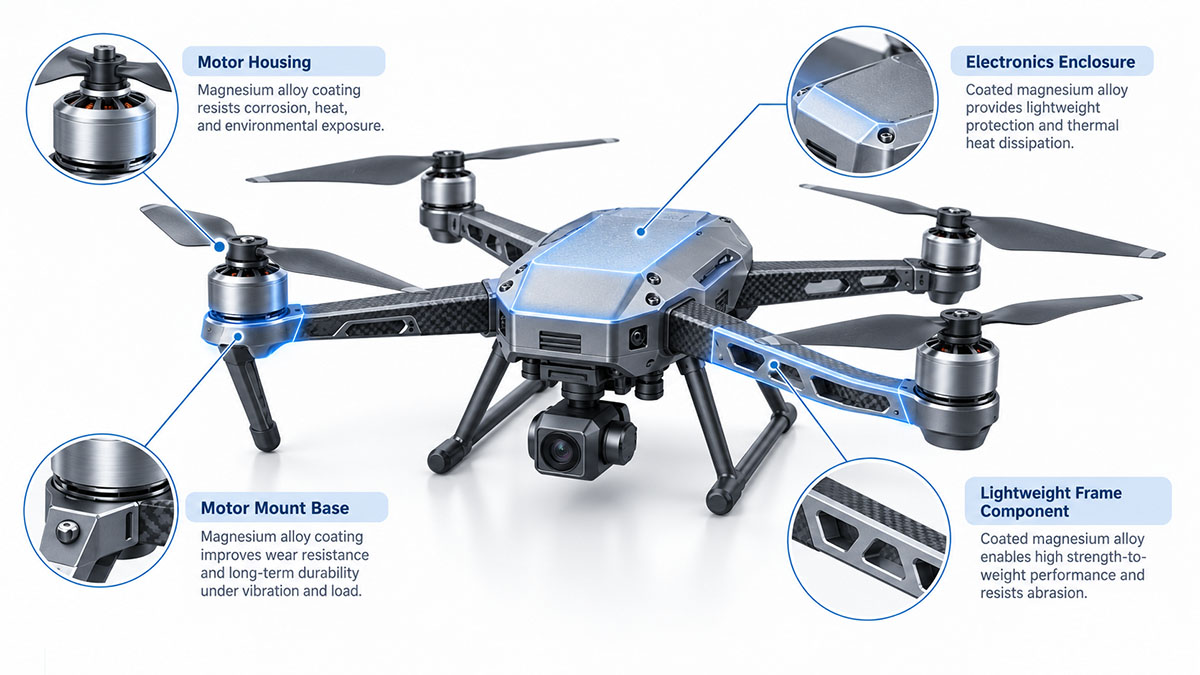 UAVs and Drones
Weight reduction has a direct impact on UAV design.
Lower component mass can reduce motor load and improve the aircraft's available payload and energy efficiency.
At the same time, UAV components may operate in:
outdoor humidity
coastal environments
salt spray
high motor temperature
repeated thermal cycling
Potential applications include:
magnesium alloy motor housings
motor mounting bases
lightweight frame structures
thermal bases
electronic housings
The provided technical case describes an AZ91D magnesium alloy UAV motor housing / thermal base using a graphene–nanoceramic coating and reports improved thermal and corrosion performance.
3C Electronics
Magnesium alloys are also attractive for lightweight electronics because they provide a useful balance of:
low weight
structural rigidity
machinability
electromagnetic shielding potential
For electronic housings, the surface treatment may also need to provide:
corrosion resistance
heat dissipation
antistatic behavior
dimensional control
A thin magnesium alloy protective coating can therefore be useful for laptop housings, communication terminals, electronic enclosures, and similar precision assemblies.
Aerospace and Lightweight Precision Components
Aerospace and high-performance equipment place particularly strict requirements on component weight and dimensional accuracy.
Magnesium components such as:
motor bases
instrument housings
lightweight brackets
thermal structures
may need corrosion resistance while maintaining heat transfer and tight tolerances.
For these applications, coating thickness becomes an important design factor.
A thin coating is particularly valuable around threads, mating surfaces, bores, and other tolerance-sensitive areas.
How to Select the Right Magnesium Alloy Coating
The most advanced coating is not necessarily the best coating for every part.
A coating should be selected according to the actual operating conditions and component requirements.
Magnesium Alloy Surface Treatment Selection Guide
| Requirement | Recommended Direction |
|---|---|
| Basic corrosion protection only | Conventional conversion coating, MAO, or painting |
| Corrosion + wear resistance | MAO or graphene-modified MAO |
| Corrosion + antistatic performance | Graphene-modified organic coating |
| Corrosion + heat dissipation | Graphene–nanoceramic nano coating |
| Tight dimensional tolerance | Thin nano coating |
| Threads / microchannels / complex cavities | Uniform thin-film process |
| Cost-sensitive high-volume structural part | Conventional surface treatment may be preferable |
| High-value lightweight thermal component | Advanced nano coating is more suitable |
A graphene nanoceramic coating becomes particularly attractive when four requirements appear together:
The component must be lightweight.
The component generates or transfers heat.
The component requires strong corrosion protection.
The component has strict dimensional tolerances.
If the part does not generate heat and only requires basic environmental protection, conventional surface treatment may still provide better economic value.
Does Graphene Coating Cost More Than Conventional Magnesium Surface Treatment?
In most cases, advanced graphene–nanoceramic nano deposition costs more per process step than conventional MAO or painting.
However, the cost should not be evaluated only by the price of graphene material.
According to the supplied technical material, the major cost drivers include:
deposition equipment
tooling and fixtures
process development
part complexity
yield control
surface pretreatment
environmental treatment
production volume
Graphene powder itself is not necessarily the dominant cost.
For example, graphene-modified MAO may only require modification of an existing electrolyte system and can therefore be more economical than a completely new deposition process.
By contrast, specialized graphene–nanoceramic nano deposition requires dedicated equipment and process control.
However, lifecycle cost should also be considered.
A single multifunctional coating may reduce the need for separate:
oxidation + sealing + painting
steps.
For high-value robot, UAV, communication, and precision components, reducing process steps, coating thickness, field corrosion failures, and thermal management problems can justify a higher initial coating cost.
Magnesium alloy offers significant advantages for lightweight engineering, but its high chemical activity makes surface protection essential.
Traditional magnesium alloy surface treatments such as micro-arc oxidation, anodizing, painting, and electrophoretic coating remain effective for many applications.
However, emerging industries increasingly require more than corrosion protection alone.
Humanoid robots, UAVs, electronic equipment, and lightweight precision machinery may require the same component to provide:
low weight + corrosion resistance + heat dissipation + wear resistance + dimensional accuracy
This is where magnesium alloy nano coating technology becomes particularly valuable.
By combining graphene with nanoceramic materials, a thin composite coating can be engineered to improve corrosion barrier performance while supporting thermal management and mechanical protection.
For cost-sensitive components with no thermal requirement, conventional MAO or protective coatings may remain the most economical choice.
For heat-generating, lightweight, complex, and tolerance-sensitive magnesium components, however, a graphene–nanoceramic magnesium alloy coating provides a promising route toward multifunctional surface protection.


