



1. A Complete Guide to Deburring CNC Machined Metal Alloys
1.1 Why Deburring Matters for Different Materials
Burrs are common in CNC Machining, especially during milling, drilling, and turning. Different materials produce different types of burrs. Magnesium alloys are relatively soft and prone to burr formation, titanium alloys produce tough burrs that are difficult to remove, and stainless steel may develop work-hardened edges.
Unremoved burrs can affect dimensional accuracy, part assembly, sealing performance, and surface quality. Choosing the right deburring method for each material is essential for precision CNC machined parts.
1.2 Four Main CNC Deburring Processes
1. Mechanical Deburring: CNC chamfering, manual deburring, vibratory finishing, and abrasive blasting.
2. Flexible Media Deburring: Magnetic abrasive finishing, abrasive flow machining, and ultrasonic deburring.
3. Electrochemical Deburring: Uses controlled electrochemical reactions to remove burrs from complex edges and internal holes.
4. Thermal and Laser Deburring: Uses thermal energy or focused laser beams to remove burrs from complex geometries and hard-to-reach areas.
The right method depends on material type, part geometry, burr size, tolerance requirements, and surface finish.
1.3 Material-Specific Deburring Challenges in CNC Machining
Material | Hardness | Burr Behavior | Key Deburring Risks | Critical Note |
Aluminum 6061 / 7075 | HB 60–150 | Fine burrs (0.02–0.10 mm); tearing on thin walls | Over-cutting, anodizing defects, local overheating | Use sharp, high-rake tools; machine chamfers first |
Magnesium AZ31B / AZ91D | HB 45–90 | Soft, fine burrs; edge deformation | Fire risk from magnesium dust, deformation, over-grinding | Avoid dry grinding; use approved wet methods and avoid steel shot |
Titanium TC4 / Ti-6Al-4V | HB 260–330 | Hard, tough burrs; work hardening | Heat buildup, oxidation, microcracks, surface damage | Use low-load finishing and protect critical surfaces |
Stainless Steel 304 / 316 | HB 150–220 | Tough, work-hardened burrs; burr reformation | Difficult removal, tool wear, edge tearing | Use coated tools, controlled pressure, and a final finishing pass |
1.4 Deburring Methods for Different Metal Alloys
1. Deburring Process Suitability for Aluminum, Magnesium, Titanium, and Stainless Steel Alloys
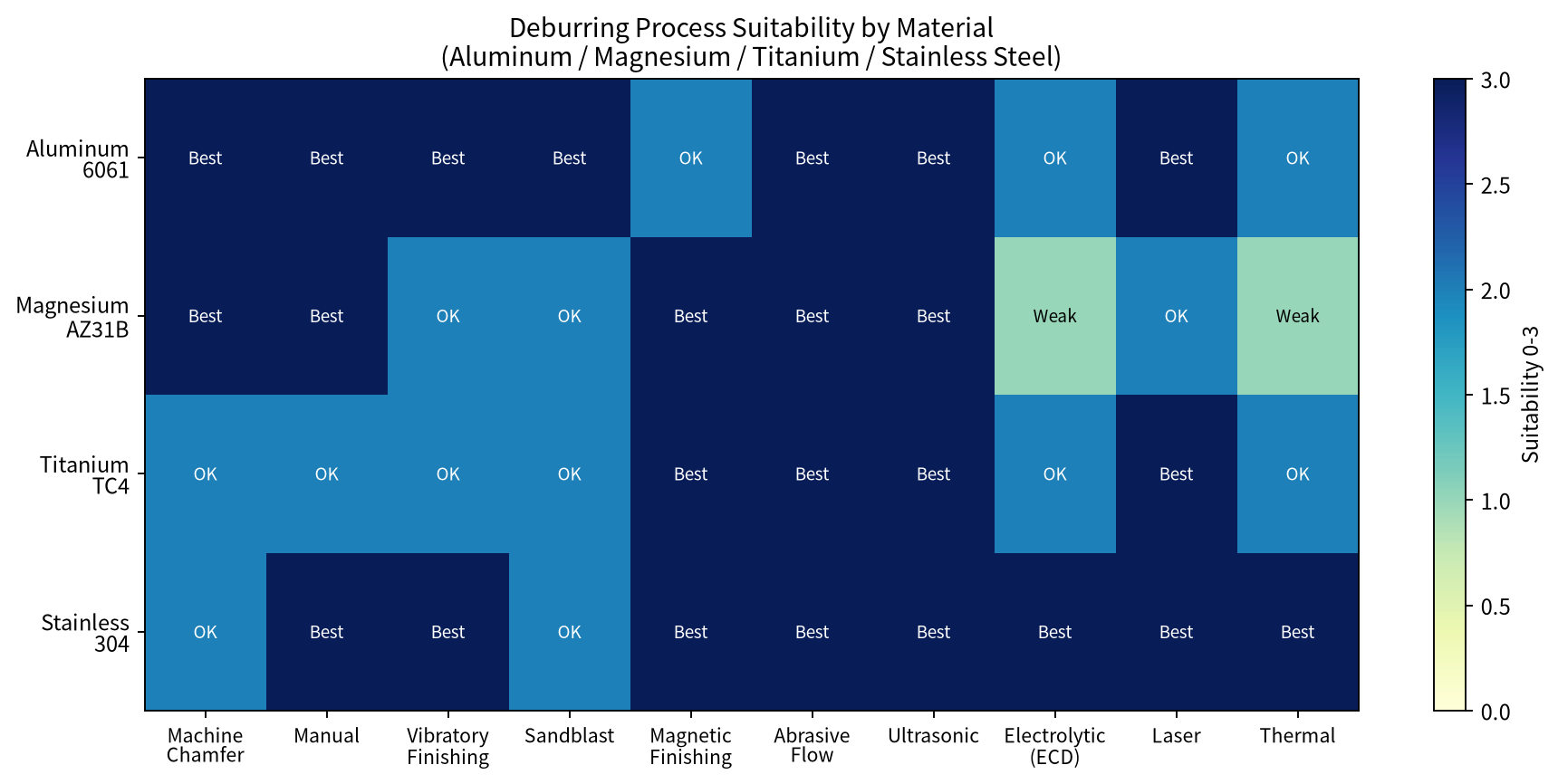
1.6 Recommended Deburring Methods for Different Metal Alloys
Material | Recommended Primary | Recommended Secondary | Avoid / Caution |
Aluminum | Machine chamfering + vibratory finishing | Magnetic finishing / laser deburring for thin-wall parts | Avoid chemical etching on anodizing-critical surfaces due to pitting risk |
Magnesium | Machine chamfering + approved wet magnetic finishing | Ultrasonic finishing for micro-burrs | Avoid thermal deburring, dry grinding, and steel shot due to fire and explosion risks |
Titanium | Machine chamfering + abrasive flow machining for internal passages | Electrochemical deburring (ECD) / laser deburring for thin-wall parts | Control oxidation during thermal processing; avoid excessive grinding stress |
Stainless Steel | Machine chamfering + vibratory finishing | Electrochemical deburring (ECD) / abrasive flow machining | Protect datum surfaces and threads during vibratory finishing |
2.DFM (Design for Manufacturability): How to Minimize Burrs in CNC Machining
The most effective way to reduce burrs is to prevent them during the design stage. Engineers should consider edge geometry, tool accessibility, deburring methods, and inspection requirements when preparing technical drawings. Proper DFM design helps reduce burr formation, machining costs, and post-processing time.
Design Action | Aluminum | Magnesium | Titanium | Stainless Steel |
Replace sharp edges with fillets (R ≥ 0.5 mm) or chamfers (0.1–0.2 mm) | Yes | Yes | Yes | Yes |
Add a guide counterbore at cross-hole outlets | Yes | Yes | Yes | Yes |
Add temporary support ribs in thin-wall areas | Yes | Critical | Yes | Yes |
Use sharp, high-rake tools (12°–20°) and climb milling | Yes | Yes | Yes (rigid setup required) | Yes |
Add an in-machine chamfering pass after finishing | Yes | Yes | Yes | Yes |
Specify allowable burr height: ≤0.05 mm on mating surfaces and ≤0.1 mm on non-mating surfaces | Yes | Yes | Yes | Yes |
Specify edge condition and chamfer/radius tolerances according to ISO 13715 | Yes | Yes | Yes | Yes |
Deburring Inspection & Material-Specific Precautions
Burr Inspection: Use a magnifier, profilometer, and cotton cloth wipe test to check for residual burrs, especially around holes and threads.
Magnesium Alloys: Use validated wet deburring processes. Avoid dry grinding due to the fire and explosion risks associated with magnesium dust.
Aluminum Alloys: After electrolytic or chemical deburring, thoroughly rinse, neutralize when required, and dry according to the process specification to prevent corrosion and chemical residue.
Before Surface Treatment: Remove all chips and burrs before anodizing or passivation to prevent surface defects and pitting.
3.Why Choose Us for CNC Deburring & Finishing
Material-Specific Solutions: Select suitable deburring methods for aluminum, magnesium, titanium, and stainless steel alloys.
DFM Engineering Support: Review drawings and optimize edge geometry, chamfers, radii, and cross-hole designs to reduce burr formation.
Combined Finishing Processes: Integrate CNC chamfering, vibratory, magnetic, and ultrasonic finishing for consistent edge quality.
Material-Specific Process Control: Apply appropriate safety and process controls to minimize fire, oxidation, deformation, and surface damage risks.
Quality Inspection: Define burr-height requirements, edge conditions, and inspection criteria according to customer specifications and ISO 13715 where applicable.
Complete Documentation: Provide inspection reports, deburring records, and material certificates according to project requirements.
4. RFQ Requirements: What to Include for CNC Machining & Deburring Quotes
Item | Required Information |
Drawing & 3D Model | 2D drawings (PDF/DWG) and 3D files (STEP/IGES), including edge and chamfer specifications |
Material Grade | Aluminum 6061/7075, Magnesium AZ31B/AZ91D, Titanium TC4/Ti-6Al-4V, Stainless Steel 304/316 |
Burr & Surface Requirements | Allowable burr height, mating/non-mating surfaces, Ra requirements, anodizing or passivation |
Geometry Details | Thin walls, cross holes, deep cavities, threads, and datum surfaces requiring protection |
Quantity & Lead Time | Prototype, batch, or mass production quantities and target delivery date |
Inspection Requirements | Burr inspection, surface finish reports, and edge/chamfer tolerances according to ISO 13715 where applicable |
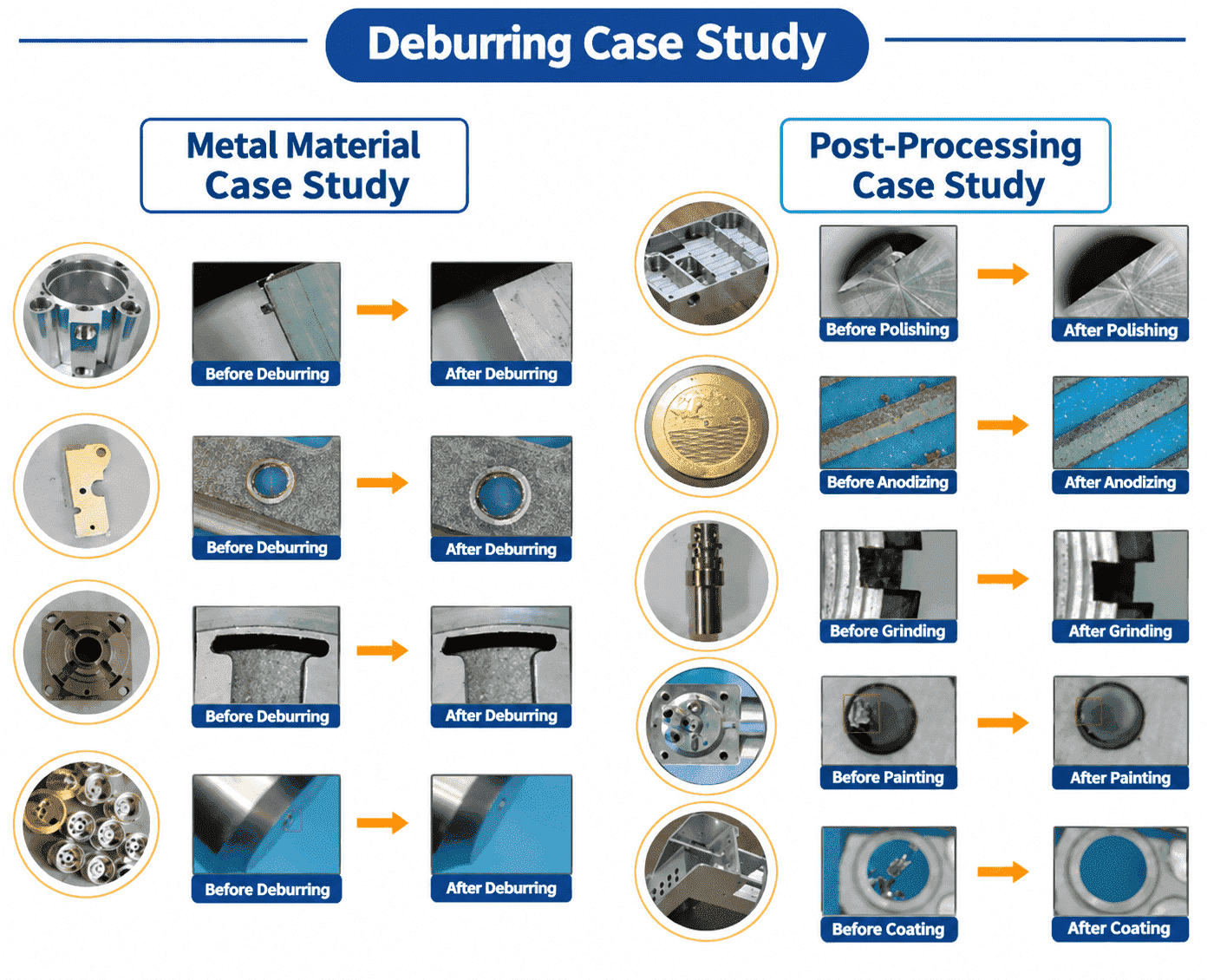
5.CNC Deburring Case Study: Precision Edge Finishing for Complex Metal Parts
5.1 Project Overview
In CNC machining, burrs can affect dimensional accuracy, assembly performance, and surface quality. For complex metal components, removing burrs from cross holes, threads, deep cavities, and intersecting edges requires careful process planning.
This case study demonstrates how Huazheng Precision approaches deburring challenges through integrated CNC machining, targeted edge finishing, and quality inspection.
5.2 Customer Challenges
The customer required precision-machined metal components with clean edges and consistent finishing quality.
Key challenges included:
Cross-Hole Burrs: Burrs formed at intersecting holes were difficult to access.
Complex Geometries: Deep cavities and narrow features limited tool accessibility.
Thin-Wall Structures: Excessive deburring could deform thin sections or damage edges.
Assembly Requirements: Burrs on mating surfaces and threaded holes could affect component assembly.
Surface Protection: Critical surfaces and dimensional features needed protection during finishing.
5.3 Our Deburring Solutions
Huazheng Precision selected suitable deburring methods based on part geometry, material properties, and drawing requirements.
Process | Application | Purpose |
CNC Chamfering | Accessible edges and hole openings | Create consistent edge conditions |
Manual Deburring | Localized burrs and complex details | Remove residual burrs precisely |
Magnetic Finishing | Small parts and selected internal features | Improve edge consistency |
Vibratory Finishing | Suitable batch components | Remove minor burrs and improve surface appearance |
Ultrasonic Cleaning | Machined holes and cavities | Remove residual chips and contaminants |
5.4 Quality Control
Each part is inspected according to the customer's drawings and technical specifications.
Check edges, cross holes, and threaded features.
Inspect critical dimensions using precision measuring equipment.
Verify that burr removal does not damage mating surfaces or functional edges.
Clean parts thoroughly before final inspection and packaging.
5.5 Project Results
The integrated deburring process helps address common finishing problems in CNC-machined components:
More consistent edge conditions.
Reduced residual burrs around holes and intersecting features.
Better protection of critical dimensions and functional surfaces.
Improved readiness for assembly and subsequent surface treatment.
More stable finishing quality across production batches.
5.6 Why Choose Huazheng Precision?
Huazheng Precision provides integrated CNC machining and deburring solutions for aluminum, magnesium, titanium, and stainless steel components.
With 5-Axis CNC Machining capabilities, engineering support, and precision inspection equipment, we help customers manage complex part geometries and edge-finishing requirements from prototyping to batch production.
5.7 Request a CNC Deburring Solution
Have parts with difficult burrs, cross holes, deep cavities, or complex edges?
Send Huazheng Precision your 2D drawings or 3D CAD files. Our engineering team can evaluate the machining and deburring requirements and recommend a suitable manufacturing solution.
Contact us today for a CNC machining and deburring quotation.
5. FAQ: CNC Deburring Frequently Asked Questions
Q1: Why do CNC machined parts develop burrs?
A: Burrs form during cutting, drilling, and milling due to material deformation, tool wear, and chip formation. Proper machining parameters and deburring processes help control burr size.
Q2: What is the best deburring method for magnesium alloys?
A: Machine chamfering and validated wet deburring methods are recommended. Avoid dry grinding and uncontrolled processes due to magnesium dust fire and explosion risks.
Q3: How do you deburr Titanium Alloy Parts without damaging the surface?
A: Use machine chamfering, controlled abrasive flow machining, or suitable precision deburring methods. Avoid excessive grinding and heat buildup.
Q4: Is electrochemical deburring (ECD) suitable for all metals?
A: No. ECD is suitable for selected conductive metals, including certain stainless steel and titanium alloys. Material compatibility, electrolyte selection, and post-treatment must be evaluated.
Q5: Can vibratory finishing damage CNC machined parts?
A: Yes. Excessive finishing may round sharp edges or damage threads and datum surfaces. Protective masking and controlled finishing parameters are essential.
Q6: What burr tolerance should be specified in technical drawings?
A: Specify allowable burr height according to functional requirements. Typical reference values are ≤0.05 mm for mating surfaces and ≤0.1 mm for non-mating surfaces, subject to customer approval.
Q7: How can deburring prevent anodizing defects on aluminum parts?
A: Remove burrs and machining chips before anodizing. Proper cleaning and pretreatment help reduce surface defects, including pits and uneven coating.
6.Summarize
Different metal alloys require different CNC deburring strategies. Aluminum needs precise edge control, magnesium requires strict fire-risk management, titanium needs low-stress finishing, and stainless steel requires effective removal of tough, work-hardened burrs.
Huazheng Precision provides CNC machining and deburring solutions for aluminum, magnesium, titanium, and stainless steel components, supporting precision parts from prototyping to batch production.
Send us your 2D drawings or 3D CAD files for a professional evaluation and quotation. Huazheng Precision provides customized CNC machining and deburring solutions for aluminum, magnesium, titanium, and stainless steel parts.


