



Laser cleaning is an advanced surface treatment technology that uses concentrated laser energy to remove contaminants, oxide films, rust, paint, oil, and other unwanted surface layers without direct mechanical contact. Compared with traditional cleaning methods such as grinding, chemical cleaning, and abrasive blasting, laser cleaning offers significant advantages in precision, environmental performance, process controllability, and automation.
In modern manufacturing, laser cleaning technology is increasingly being evaluated for aluminum alloys, magnesium alloys, titanium alloys, and carbon steel. These materials are widely used in aerospace, automotive, shipbuilding, medical equipment, heavy machinery, and other demanding industries.
One of the most important applications is laser cleaning before welding. Removing surface oxides and contaminants can improve surface cleanliness, reduce weld porosity, and improve the consistency and mechanical performance of welded joints.
This article examines the working principles, cleaning methods, operating modes, and typical applications of laser cleaning for four representative materials: aluminum alloy, titanium alloy, magnesium alloy, and carbon steel.
1. How Does Laser Cleaning Work?
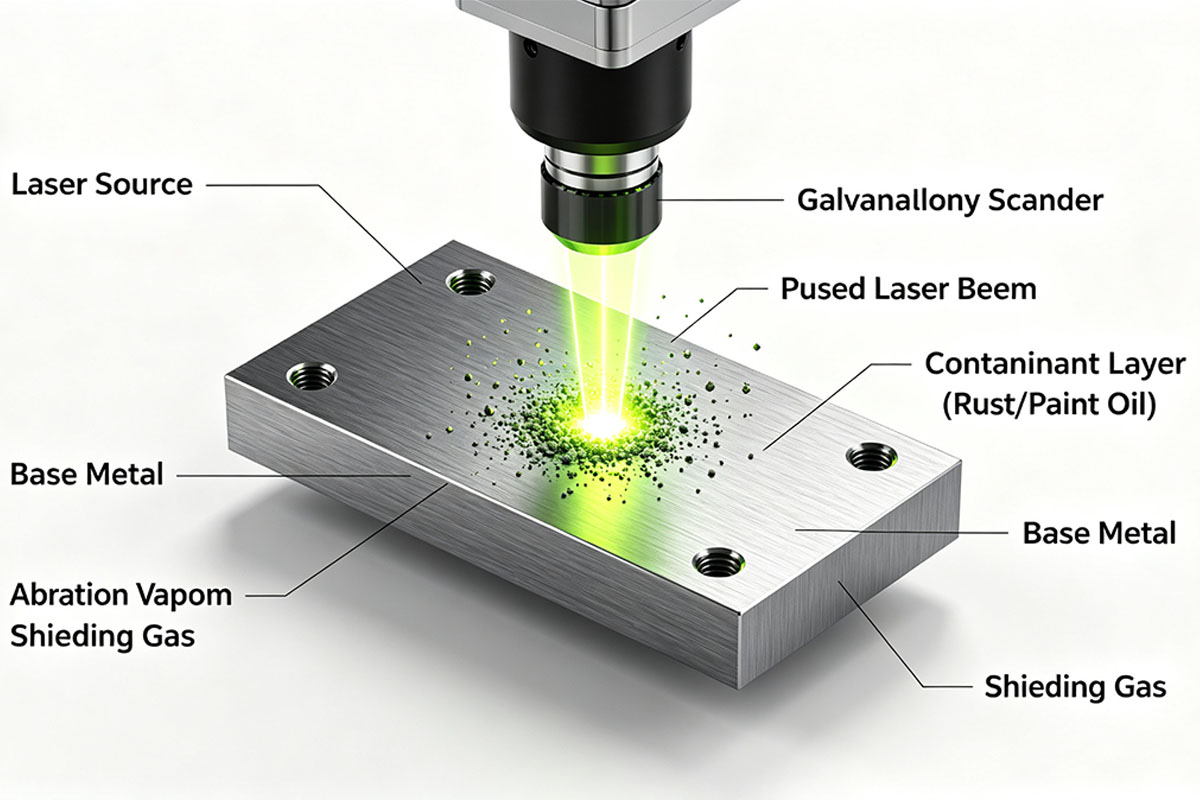
Laser cleaning works by directing a high-energy laser beam onto the surface of a workpiece. A galvanometer scanner or optical scanning system rapidly moves the laser beam across the target area.
When the laser energy is absorbed by the contamination layer, several physical mechanisms can occur. Depending on the material, laser parameters, and surface structure, contaminants may be removed through evaporation, thermal expansion, vibration, ablation, cracking, or mechanical shock.
The basic principle can be expressed as:
Laser energy → material absorption → thermal/vibrational or ablation effect → separation of contaminants → clean surface
The laser parameters, including laser wavelength, pulse duration, power, energy density, scanning speed, repetition frequency, and overlap rate, must be carefully controlled to remove the unwanted layer while minimizing damage to the substrate.
Three Widely Accepted Laser Cleaning Mechanisms
1.1 Removal of Microparticle Contaminants
For small particles attached to a surface, the cleaning force generated by laser irradiation can overcome the adhesion force between the particles and the substrate.
The particles are therefore detached from the surface without requiring mechanical contact.
This mechanism is particularly useful for:
Fine particle removal
Surface dust removal
Precision component cleaning
Electronic and optical components
Pre-treatment before assembly
1.2 Removal of Paint and Rust
Paint and rust removal can involve both vibration and ablation effects.
Paint is generally considered a heterogeneous coating layer, while rust can be treated as a surface reaction layer. The laser creates rapid thermal and mechanical effects that cause the unwanted layer to crack, detach, or vaporize.
This makes laser cleaning suitable for:
Laser paint removal
Laser rust removal
Coating removal
Surface preparation
Maintenance of metal components
1.3 Removal of Mold Surface Contaminants
For mold cleaning, high-temperature evaporation and vaporization can remove accumulated contaminants. At the same time, acoustic or shock-wave effects generated during laser irradiation can create additional mechanical forces.
This combination allows laser cleaning to remove contamination from complex mold surfaces while reducing the need for abrasive mechanical cleaning.
2. Major Types of Laser Cleaning
Laser cleaning processes can be broadly classified according to the interaction mechanism between the laser, cleaning medium, contamination, and substrate.
| Cleaning Type | Working Principle | Core Characteristics | Typical Applications |
|---|---|---|---|
| Dry Laser Cleaning | Direct laser irradiation causes thermal expansion or vibration of the substrate or contaminants | Simple process, no pre-treatment required | Rust removal, paint removal, oxide scale removal |
| Wet Laser Cleaning | A liquid film is applied to the workpiece and rapidly vaporized by laser irradiation | Stronger cleaning force and lower thermal influence | Precision components, cultural relics, stain removal |
| Plasma-Assisted Laser Cleaning | Laser-induced plasma generates shock waves that remove contaminants | Laser energy does not directly act on the substrate, potentially reducing substrate damage | Ultra-thin materials and high-precision surfaces |
2.1 Dry Laser Cleaning
Dry laser cleaning is the most straightforward process. The laser directly interacts with the contamination layer or substrate.
When the laser energy is absorbed, rapid thermal expansion, thermal vibration, or ablation causes the contamination to separate from the workpiece.
The major advantages are simple equipment configuration and the absence of chemical cleaning agents.
2.2 Wet Laser Cleaning
In wet laser cleaning, a thin liquid film is first applied to the workpiece. Laser irradiation rapidly vaporizes the liquid film, generating an impact or shock-wave effect.
This additional mechanical force can improve cleaning efficiency while reducing direct thermal influence on the substrate.
2.3 Plasma-Assisted Laser Cleaning
Laser-induced plasma can generate a localized shock wave that acts on the contamination layer.
Because the cleaning mechanism relies more heavily on the plasma-generated mechanical effect rather than direct laser-material interaction, this approach has potential advantages for ultra-thin substrates and high-precision surfaces.
3. Handheld vs. Automated Laser Cleaning
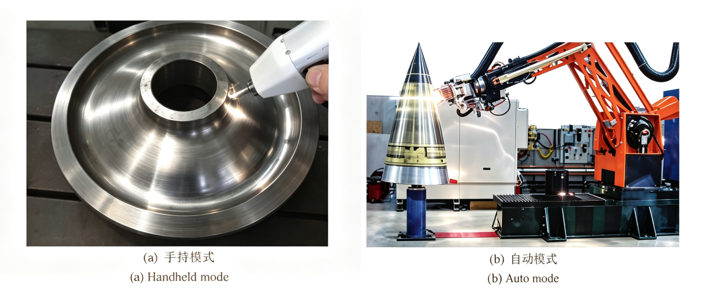
Laser cleaning equipment can also be classified according to how the laser cleaning head is operated.
| Operating Mode | Core Component | Advantages | Limitations | Typical Applications |
| Handheld | Handheld laser cleaning gun | Flexible, portable, suitable for irregular surfaces | Operator consistency depends on experience | Irregular surfaces, rust, oxide scale, paint removal, field repair |
| Automated | Laser cleaning head mounted on robotic arm | High efficiency, high precision, lower labor cost | Less suitable for highly irregular workpieces | Production lines and standardized parts |
3.1 Handheld Laser Cleaning
A handheld laser cleaning gun gives operators considerable freedom to move around complex or irregular workpieces.
It is particularly suitable for:
On-site maintenance
Large structures
Irregular surfaces
Rust removal
Paint stripping
Oxide scale removal
Equipment repair
The main limitation is process consistency. Cleaning quality can depend on the operator's experience, scanning speed, working distance, and movement pattern.
3.2 Automated Laser Cleaning
For mass production, the laser cleaning head can be integrated with a robotic arm or other motion system.
The robot follows a programmed trajectory and maintains more consistent scanning conditions.
Key benefits include:
High repeatability
Consistent cleaning quality
High production efficiency
Reduced manual labor
Easier process standardization
Automated laser cleaning is particularly suitable for standardized components and production lines.
4. Laser Cleaning Applications for Four Common Materials
The interaction between laser energy and the substrate is highly material-dependent. Aluminum alloys, magnesium alloys, titanium alloys, and carbon steel have different thermal properties, surface oxides, coatings, and absorption characteristics.
Therefore, laser cleaning parameters cannot simply be transferred from one material to another.
Overview of Applications
| Material | Main Cleaning Target | Core Advantage | Typical Applications |
| Aluminum Alloy | Oxide film, aerospace coating, paint | Non-contact, high precision, limited substrate damage | Aerospace skins and structural components |
| Titanium Alloy | Oxide layer, epoxy zinc yellow coating, paint, weld discoloration | Effective oxide removal and improved welding quality | Aerospace, shipbuilding, medical |
| Magnesium Alloy | Surface oxide film | Removes oxide film and improves welding stability | Aircraft and lightweight structures |
| Carbon Steel | Zinc-rich primer, paint, rust | Efficient and environmentally friendly cleaning | Ships, heavy equipment, steel structures |
5. Laser Cleaning of Aluminum Alloys
Aluminum alloys are widely used in aerospace and transportation because of their low density, high specific strength, and corrosion resistance.
However, aluminum surfaces can develop oxide films and may also be protected by paint or other coatings. These surface layers can interfere with welding and subsequent manufacturing processes.
Aluminum alloy laser cleaning provides a non-contact approach for removing unwanted surface layers while maintaining the integrity of the substrate.
5.1 Aluminum Alloy Oxide and Paint Removal
Research has investigated laser cleaning of several aluminum alloys, including 2A12, 5083, 2024, LY12/2219, and 5A06.
Typical targets include:
Surface oxide films
Aerospace coatings
TB06-9 coatings
Paint layers
Welding surface contamination
One study involving 2A12 aluminum alloy and TB06-9 coating used a two-step nanosecond pulsed laser process.
The reported parameters were:
First step:
Power: 40 W
Frequency: 20 kHz
Scanning speed: 1040 mm/s
Line spacing: 0.052 mm
Second step:
Power: 80 W
Frequency: 1000 kHz
Scanning speed: 690 mm/s
Line spacing: 0.0345 mm
The coating was effectively removed while maintaining the original mechanical properties of the material.
5.2 Laser Cleaning for Aluminum Welding Preparation
Laser cleaning can also be used before aluminum alloy welding.
For aluminum alloys, studies have compared 100 ns laser processing with picosecond laser cleaning.
Under reported experimental conditions:
100 ns laser: 100 W, approximately 40% overlap
Picosecond laser: 100 W, approximately 60% overlap
The picosecond process produced better surface quality, while the 100 ns process provided higher processing efficiency.
Argon-assisted cleaning can further reduce weld porosity during subsequent welding.
5.3 Measured Improvement in Aluminum Alloy Surface Quality
For 5A06 aluminum alloy, laser cleaning reduced the oxygen mass fraction on the surface from 19.85% to 1.74%.
The reported tensile strength increased from 268.8 MPa to 293.5 MPa, while hardness was approximately 85 HV.
These results demonstrate the potential of laser cleaning as a pre-treatment technology for aluminum alloy welding.
6. Laser Cleaning of Titanium Alloys
Titanium alloys are widely used in aerospace, marine engineering, medical equipment, and other applications where high strength-to-weight ratio and corrosion resistance are important.
However, titanium welding is highly sensitive to surface contamination and oxide layers.
As a result, titanium alloy laser cleaning is particularly valuable for welding preparation.
6.1 Titanium Oxide Removal Before Welding
For TC11 titanium alloy, laser cleaning was investigated for removing contaminants and oxide layers before welding.
The reported result showed that the cleaned weld achieved a QJ1666A-2011 Class I quality level, with no observed porosity or inclusions after electron beam welding.
For Ti6Al4V titanium alloy, laser cleaning can effectively remove the oxide layer before welding and reduce surface roughness and weld porosity under appropriate process conditions.
6.2 Laser Removal of Titanium Alloy Coatings
For TC4 titanium alloy with an epoxy zinc yellow coating, pulsed fiber laser cleaning was investigated.
Reported parameters included:
Energy density: 4.00 J/cm²
Cleaning speed: 3 mm/s
The coating was completely removed.
The resulting surface phases were mainly Ti and Ti₆O. Surface roughness remained close to the original substrate, while hardness increased by approximately 7.4%.
6.3 Laser Cleaning of Titanium Weld Oxide Discoloration
Titanium welding can generate yellow, blue, or purple oxide discoloration.
For TA5 marine titanium alloy, pulsed laser cleaning was used to remove these oxide colors from weld surfaces.
After cleaning:
The weld surface became silver-white.
Oxygen content was reported at approximately 8.26%–8.65%.
Joint tensile strength reached 767 MPa.
The tensile strength was higher than that of the base material.
Fracture occurred in the base material rather than the weld.
This demonstrates the potential of laser cleaning for titanium welding surface treatment.
7. Laser Cleaning of Magnesium Alloys
Magnesium alloys are attractive lightweight materials used in aircraft and other lightweight structures.
However, their surface oxide films can negatively affect welding quality.
Compared with aluminum and titanium alloys, research on magnesium alloy laser cleaning is currently more limited, but existing research indicates significant potential.
7.1 AZ31B Magnesium Alloy Laser Cleaning
For AZ31B magnesium alloy, nanosecond pulsed laser cleaning was compared with steel-brush grinding and untreated surfaces.
The reported results included:
Effective removal of the surface oxide film.
Formation of a fine surface microstructure.
Reduction of welding pores.
Improved molten-pool stability.
More uniform and finer weld ripples.
Fewer pores and cracks.
Most importantly, the joint elongation after laser cleaning was reported to be:
50.3% higher than the untreated sample
16.4% higher than the steel-brush-treated sample
These results suggest that laser cleaning can provide advantages over conventional mechanical surface preparation.
7.2 Future Potential of Magnesium Alloy Laser Cleaning
Because magnesium alloys are increasingly relevant to lightweight manufacturing, laser cleaning represents an area with considerable research and industrial potential.
Further work is needed to establish optimized laser wavelengths, pulse widths, energy densities, scanning strategies, and automated cleaning processes for different magnesium alloy grades.
8. Laser Cleaning of Carbon Steel
Carbon steel is one of the most widely used engineering materials and can be found in ships, heavy equipment, steel structures, machinery, and industrial components.
Unlike lightweight alloys, carbon steel laser cleaning is frequently associated with rust removal, paint stripping, and coating removal.
8.1 Removal of Zinc-Rich Primer
For EH36 marine carbon steel, pulsed laser cleaning was investigated for removing zinc-rich primer.
A reported process used:
Laser power: 50–100 W
Cleaning cycles: 2–3 passes
The primer could be effectively removed, exposing a bright surface.
The treatment changed surface roughness but had little influence on the microstructure and mechanical properties of the substrate.
8.2 Laser Removal of Industrial Paint
For carbon steel used in household equipment housings, pulsed laser cleaning was investigated for amino paint removal.
Reported parameters included:
Frequency: 250 kHz
Scanning speed: 200 mm/s
Pulse duration: 0.2 μs
Power: 90 W
Scanning spacing: 0.04 mm
The resulting surface remained smooth and retained its original morphology.
The measured roughness was approximately 1.325 μm, with scanning spacing identified as the most influential parameter.
8.3 Carbon Steel Rust Removal
For Q235B carbon steel, a 1080 nm continuous-wave laser was used for rust removal.
Reported parameters included:
Power: 7 kW
Scanning speed: 500 mm/s
The rust was effectively removed, with surface roughness reduced to approximately 3.68 μm.
The surface hardness after cleaning was reported to be approximately four times that of the substrate.
For 45 steel containing Fe₃O₄/Fe₂O₃ rust layers, nanofiber laser cleaning was also investigated.
Reported parameters included:
Power: 500 W
Frequency: 25 kHz
Scanning frequency: 115 Hz
Scanning speed: 1 mm/s
Cleaning passes: 15
The rust layer was effectively removed while the surface roughness was reduced and hardness and material phases remained largely unchanged.
9. Comparison of Laser Cleaning Applications by Material
| Material | Typical Contamination | Main Laser Cleaning Purpose | Major Benefit |
| Aluminum Alloy | Oxide film, paint, aerospace coating | Surface preparation and welding pre-treatment | High precision and limited substrate damage |
| Titanium Alloy | Oxide layer, coating, weld discoloration | Welding preparation and coating removal | Reduced weld porosity and improved weld quality |
| Magnesium Alloy | Oxide film | Welding preparation | Improved molten-pool stability and joint elongation |
| Carbon Steel | Rust, paint, zinc-rich primer | Rust removal and coating stripping | High efficiency and reduced dependence on abrasive/chemical methods |
A common value chain can be identified across these four materials:
Surface contamination removal → cleaner substrate → improved welding or coating performance → reduced defects → improved manufacturing consistency
This makes laser cleaning more than a simple surface-cleaning technology. It can also function as an important pre-treatment process within advanced manufacturing workflows.
10. Key Laser Cleaning Parameters
The cleaning result is determined not only by laser power but by the combined effect of multiple process parameters.
Important parameters include:
10.1 Laser Power
Higher laser power generally increases the energy delivered to the surface.
However, excessive power can increase thermal damage, cause substrate melting, or alter the surface microstructure.
Therefore, maximum power is not necessarily the optimal cleaning condition.
10.2 Energy Density
Energy density is particularly important for coating and oxide removal.
The laser must provide sufficient energy to remove the contamination layer while keeping the substrate below a damaging threshold.
10.3 Scanning Speed
A lower scanning speed increases the energy deposited per unit area.
A higher scanning speed can improve productivity but may reduce cleaning efficiency if insufficient energy reaches the contamination layer.
10.4 Pulse Frequency
Pulse frequency affects the energy distribution and overlap between individual laser pulses.
It must be selected together with power and scanning speed.
10.5 Scanning Overlap
The overlap ratio determines how frequently adjacent laser paths interact with the same surface area.
Insufficient overlap may leave uncleaned regions, while excessive overlap can increase heat accumulation.
10.6 Line Spacing
Line spacing is particularly important for automated laser scanning.
The carbon steel paint-removal study described above demonstrated that scanning spacing can have a significant influence on final surface morphology and roughness.
11. Advantages of Laser Cleaning Compared with Traditional Cleaning
Laser cleaning offers several advantages for industrial surface preparation.
Non-Contact Processing
The laser cleaning head does not need to physically touch the workpiece.
This eliminates direct mechanical abrasion and makes the process suitable for delicate or precision surfaces.
High Precision
Laser energy can be accurately controlled and concentrated on specific areas.
This makes selective coating and contamination removal possible.
Environmentally Friendly
Unlike chemical cleaning, laser cleaning does not inherently require large quantities of chemical solvents or cleaning agents.
This can reduce secondary chemical waste and improve workplace environmental conditions.
High Efficiency
High-power laser systems can process relatively large surface areas at high speed.
Automated systems can further increase production efficiency.
Process Automation
Laser cleaning heads can be integrated with robotic arms, CNC systems, or dedicated production equipment.
This allows repeatable and programmable surface treatment.
Reduced Labor Requirements
Automated laser cleaning can reduce dependence on manual grinding, brushing, or blasting operations.
12. Typical Applications of Laser Cleaning
Laser cleaning has already been investigated and applied across a variety of industrial and cultural heritage applications.
Typical applications include:
Industrial Manufacturing
Rust removal
Paint stripping
Oxide removal
Coating removal
Surface preparation
Welding Pre-Treatment
Laser cleaning can remove oxide films and contaminants before welding.
This is particularly important for:
Aluminum alloy welding
Titanium alloy welding
Magnesium alloy welding
Precision metal welding
Aerospace
Laser cleaning can be used for aerospace skins, structural components, coatings, and welding preparation.
Shipbuilding
Applications include marine steel rust removal, coating removal, and titanium alloy weld cleaning.
Automotive and New Energy Manufacturing
Potential applications include surface preparation, component cleaning, coating removal, and automated production-line cleaning.
Mold Cleaning
Laser cleaning can remove accumulated deposits and contaminants from mold surfaces without the mechanical abrasion associated with conventional cleaning methods.
Cultural Heritage Conservation
Low-damage laser cleaning has also been investigated for cleaning cultural relics and sensitive surfaces where conventional abrasive cleaning may be inappropriate.
13. How to Select a Laser Cleaning Process
There is no universal laser cleaning parameter that works for every material.
The process should be developed according to the substrate, contamination type, layer thickness, required surface quality, and production volume.
A practical selection process can include the following steps:
Step 1: Identify the Substrate
Determine whether the workpiece is aluminum, titanium, magnesium, carbon steel, stainless steel, or another material.
Step 2: Identify the Contamination
Determine whether the target is:
Rust
Oxide
Paint
Primer
Oil
Dust
Welding discoloration
Mold contamination
Step 3: Determine the Required Surface Quality
For general rust removal, processing efficiency may be the primary consideration.
For aerospace components or welding preparation, surface cleanliness and substrate integrity may be more important.
Step 4: Select the Laser Type
Possible options include:
Nanosecond pulsed lasers
Pulsed fiber lasers
Picosecond lasers
Continuous-wave lasers
Step 5: Optimize the Process Parameters
Parameters such as power, energy density, scanning speed, frequency, overlap, and line spacing should be experimentally optimized.
Step 6: Verify the Substrate
After cleaning, the surface should be evaluated for:
Roughness
Hardness
Surface morphology
Chemical composition
Microstructure
Mechanical properties
This is especially important when laser cleaning is used before welding.
14. Future Development of Laser Cleaning Technology
The growing demand for cleaner and more automated manufacturing processes is creating new opportunities for laser cleaning.
The future development of laser cleaning is likely to focus on:
Higher-Speed Cleaning
Higher-power lasers and optimized scanning systems can improve productivity for large industrial components.
Intelligent Process Control
Sensors, machine vision, and real-time monitoring can help automatically adjust laser parameters according to surface conditions.
Robotic Laser Cleaning
The integration of laser cleaning with robotic arms can enable automated processing of complex components.
Specialized Material Processes
More optimized process windows are expected to be developed for aluminum, titanium, magnesium, and other difficult-to-clean materials.
Green Manufacturing
As manufacturers seek to reduce chemical waste, abrasive media, and manual labor, laser cleaning can become an increasingly attractive alternative to conventional surface treatment.
The global laser cleaning market was reported in the provided research material to have reached approximately US$724 million in 2023, indicating the growing commercial interest in this technology.
Laser cleaning is evolving from a specialized surface treatment technique into a versatile manufacturing process for removing rust, paint, oxide films, coatings, and other contaminants.
For aluminum alloys, laser cleaning can effectively remove oxide films and aerospace coatings while providing a high-precision, non-contact surface treatment method.
For titanium alloys, its ability to remove oxide layers and weld discoloration makes it particularly valuable for welding preparation and high-quality surface treatment.
For magnesium alloys, current research is more limited, but experimental results demonstrate promising improvements in welding quality, molten-pool stability, and joint elongation.
For carbon steel, laser cleaning has strong potential for rust removal, paint stripping, primer removal, and large-scale industrial surface preparation.
Across all four materials, the fundamental value of laser cleaning lies in its combination of:
Non-contact processing + high precision + high efficiency + reduced environmental impact + process automation
As laser sources, scanning systems, robotic integration, and intelligent process control continue to develop, laser cleaning is expected to play an increasingly important role in advanced manufacturing, welding preparation, maintenance, and green production.


