



1. Introduction
Titanium alloy has become one of the most sought-after advanced engineering metals for high-end industries. Combining light weight, outstanding corrosion resistance and high-temperature strength, it outperforms aluminum, steel and stainless steel in many extreme working scenarios. However, titanium is also famous as a “hard-to-machine” material.
This article provides a complete reference for engineers and buyers: titanium alloy core characteristics with comparison tables, typical industry applications, the value that CNC Machining delivers for titanium components, machining difficulties and practical solutions, selected real-world application cases, the future trend of 5-axis CNC titanium, DFM design reminders and frequently asked questions.
2. Titanium Alloy Core Characteristics & Comparative Analysis
Titanium alloy offers a unique combination of properties that no single conventional metal can match simultaneously:
High strength-to-weight ratio: Density ~4.51 g/cm³, roughly 60% of steel, higher specific strength than alloy steel and aluminum alloy. It can maintain high tensile strength while reducing component weight.
Excellent corrosion resistance: A dense, self-healing passive TiO2 oxide film forms instantly on the surface. It resists seawater, chloride, acid and humid marine atmosphere far better than carbon steel, stainless steel and aluminum alloy.
Good thermal stability & high-temperature performance: Retains mechanical strength at 300-600℃. Near-α titanium alloys can work steadily up to 600℃, far superior to aluminum alloys which soften above ~200℃.
Low modulus of elasticity: Elastic modulus about half of steel, good elasticity and toughness, suitable for elastic components.
Non-magnetic & biocompatible: Non-magnetic, non-toxic, compatible with human tissue, widely used in medical implants.
Property | Titanium Alloy | 6061 Aluminum | 316 Stainless Steel | 4130 Alloy Steel |
Density (g/cm³) | 4.51 | 2.70 | 7.98 | 7.85 |
Specific Strength | Excellent | Good | Medium | Good |
Max Long-term Temp | 300-600℃ | <200℃<> | <300℃<> | <400℃<> |
Seawater Corrosion Resistance | Excellent | Poor | Good | Poor |
Machinability | Hard to Machine | Easy | Medium | Medium |
Relative Cost | High | Low | Medium | Low |
2.1 Titanium alloy classification supplement
Category | Typical Grades | Key Features | Typical Use |
Commercial Pure Ti | TA1 / TA2 / TA3 | Low strength, best corrosion resistance, non-heat-treatable | Corrosion service, heat exchangers |
α Ti alloy | TA5 / TA7 | Medium strength, excellent weldability, seawater resistance | Marine structures |
Near-α Ti alloy | TA11 / IMI834 | High-temperature grade | Aero-engine hot sections |
α+β Ti alloy | TC4 / Ti-6Al-4V | Most universal, balanced strength & processability | ~90% of machined titanium parts |
β Ti alloy | TB2 / TB6 | Ultra-high strength, good cold formability | Aerospace fasteners & springs |
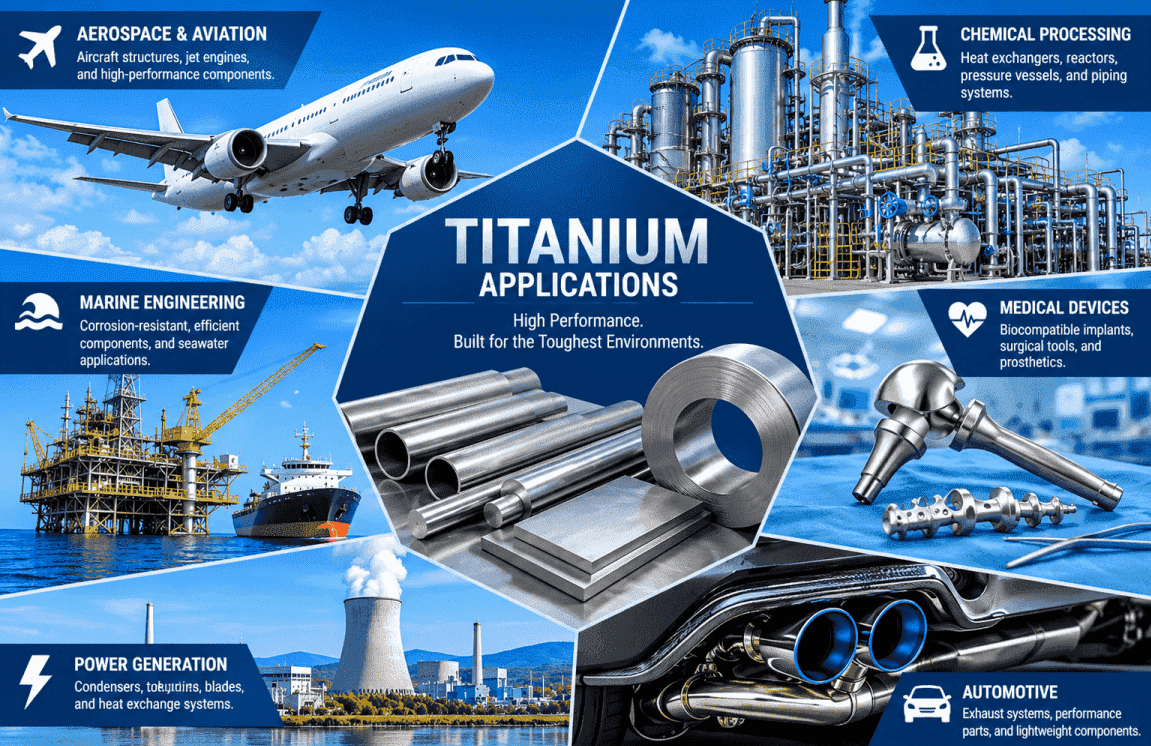
3. Industry Application
3.1 Aerospace
Titanium accounts for a growing share of modern aircraft structures. The SR71 Blackbird used up to 95% titanium to survive 3-Mach aerodynamic heating. Modern fighters (F14, F15), strategic bombers (B1) and commercial aircraft (Boeing 747) rely on titanium for airframe and engine components. Aero-engine compressor blades, disks and casings increasingly replace steel and aluminum.
3.2 Marine & Ocean Engineering
Titanium resists long-term seawater chloride corrosion. It is used in seawater desalination heat exchangers, condenser piping, deep-sea pressure hulls (Jiaolong, Fendouzhe submersibles), propellers and ship pipelines, avoiding the rusting and perforation that stainless steel often suffers.
3.3 Medical
Bone plates, dental implants and joint prostheses benefit from titanium's biocompatibility and non-rejection behaviour.
3.4 Energy, Chemical & Oil & Gas
Chemical reactors, heat exchangers and downhole tools resist acid, brine and corrosive media.
4. CNC Machining for Titanium: Industry Contribution
CNC milling and turning are the mainstream methods to produce precision titanium components. CNC machining supports all the high-end industries above in the following ways:
Enable complex 3D geometry: Aerospace blisks, thin-wall marine shells and custom medical implants cannot be finished by forging or casting alone.
Tight tolerance control: Can reach ±0.002 mm precision, meeting aerospace AS9100 and marine pressure-vessel standards.
Consistent batch stability: CNC eliminates manual error, critical for aircraft structure and deep-sea safety parts.
Material-utilization improvement: Combine near-net-shape forging blanks with finish CNC machining to reduce expensive titanium waste.
Surface-quality control: Control surface roughness and avoid microcracks, which are fatal for titanium fatigue performance.
Long-term industry support: The global Ti-6Al-4V market keeps growing. CNC capacity is the bottleneck restricting the whole titanium supply chain. A reliable CNC machining partner is the core enabler for the expansion of aerospace, deep-sea equipment and new energy.
5. Titanium Machining Difficulties & Practical Solutions
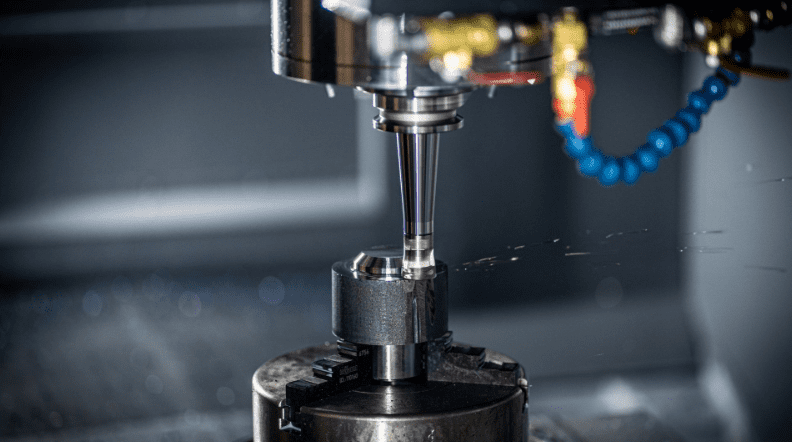
Titanium is classified as a difficult-to-machine material for five main reasons. Each difficulty has a corresponding, proven solution.
Difficulty | Root Cause | Practical Solution |
High cutting force & heat | Low thermal conductivity of titanium; heat accumulates on cutting edge, not carried away by chips | Dedicated Ti-grade carbide tools with TiAlN/AlCrN coating; lower cutting speed, moderate feed, stable chip breaking; high-pressure coolant / MQL; avoid dwell at one point |
Work hardening | Surface hardening under friction; improper machining creates residual stress and reduces fatigue life | Sharp cutting edge, avoid rubbing; pass sequence rough → semi-finish → finish with small finishing allowance; stress-relief annealing after rough machining |
Built-up edge (BUE) formation | Chemical affinity between titanium and tool material | Use coated carbide / ceramic tools; high positive rake angle; proper cutting-fluid lubrication |
Thin-wall deformation | Low elastic modulus; thin wall deflects under clamping & cutting force | DFM: add rib support; low-stress fixture, vacuum chuck, soft jaws; control clamping force; light finishing cut |
High material cost & scrap loss | Expensive titanium bar / forging blank | 3D toolpath simulation before machining; strict first-article inspection (FAI); nesting optimization to reduce waste |
Tolerance instability in batch | Machine thermal drift and tool wear shift dimensions over time | Thermally stabilized CNC machine; periodic tool-offset compensation; in-process probing & measurement |
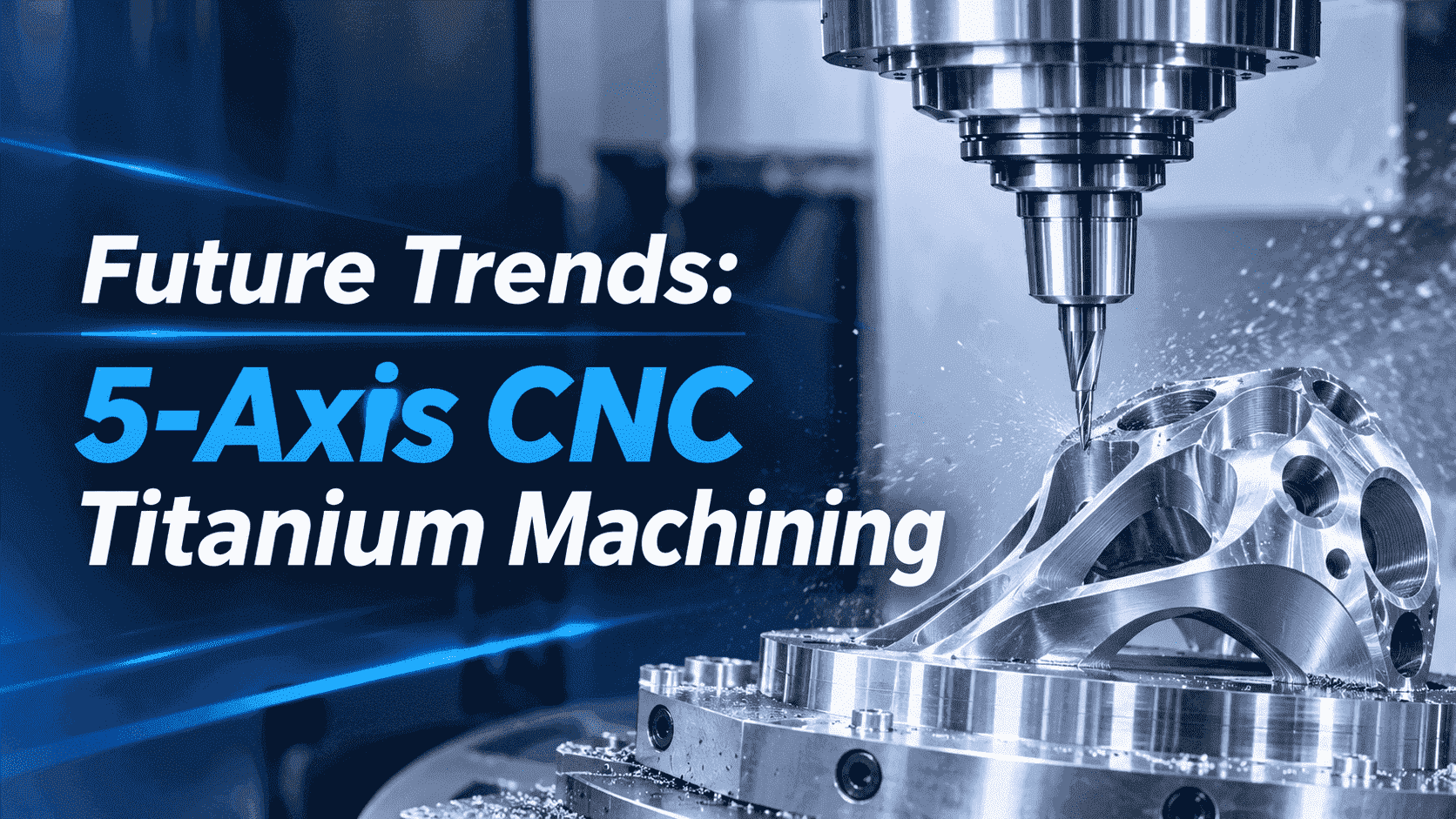
6. Future Trends: 5-Axis CNC Titanium Machining
The demand for titanium components is growing across aerospace, deep-sea exploration, new energy, medical and premium consumer electronics. 5-Axis CNC Machining is at the centre of this growth, and several clear trends are emerging:
One-setup complex machining: 5-axis simultaneous machining reduces re-fixturing, improves angular accuracy and shortens lead time for blisks, impellers and thin-wall housings.
Higher spindle speed & advanced tooling: High-torque spindles and new coated-carbide / ceramic tools increase titanium removal rates while controlling heat.
Cryogenic & high-pressure coolant: Liquid-nitrogen and through-spindle high-pressure coolant are proven to extend tool life and improve surface integrity for titanium.
Digital twin & CAM optimization: Toolpath simulation and adaptive machining reduce trial-and-error, scrap and cost for expensive titanium blanks.
Additive + subtractive hybrid: Near-net-shape additive manufacturing (DED/L-PBF) combined with finish 5-Axis Machining maximizes material utilization and reduces cost.
The future of titanium machining is not about material supply, but reliable, low-residual-stress, high-productivity 5-axis CNC processing. The factories that master these technologies will capture the growth of aerospace and deep-sea industries.
7. Why Choose Us for Titanium Alloy CNC Machining
Material-aware engineering team: We understand titanium metallurgy and cutting physics, not only CNC codes, and give DFM feedback that balances weight, dimension and corrosion/fatigue risk.
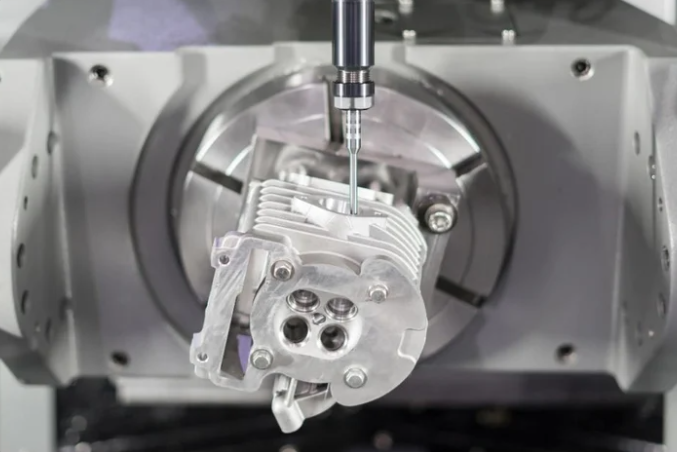
Source-factory 5-axis capability: Specialized in complex titanium thin-wall parts, supporting one-off prototypes through small-batch serial production.
Strict tight-tolerance execution: CMM inspection for key GD&T; traceable dimensional reports available on request.
Full material traceability: MTC / 3.1 material certificate per batch, compliant with ASTM B348 and AMS4911.
One-stop service: CNC machining + heat treatment + passivation/anodizing/PVD + non-destructive testing (NDT).
Proven project references: aerospace structures, deep-sea equipment, chemical corrosion parts, medical titanium components.
Tagline: We do not just cut titanium - we machine it safely, stably and fatigue-friendly.
8. Application & DFM Reminder for Titanium CNC Components
8.1 When to choose titanium (and when not)
Good fit: Load-bearing lightweight structure, high-temperature service, seawater/corrosive environment, fatigue-critical components.
Not recommended: Simple low-stress, non-corrosion parts where aluminum or steel can work; titanium would add unnecessary cost.
8.2 Critical DFM checklist for titanium parts
DFM Item | Design Recommendation | Risk if Ignored |
Internal corner radius | Add radius R ≥ 0.8 mm; avoid sharp inside corners | Tool chipping, stress concentration, crack initiation |
Minimum wall thickness | ≥ 0.8 mm for thin-wall; thinner requires process confirmation | Deflection, chatter, distortion |
Deep narrow cavity | Aspect ratio better < 4:1 | Tool deflection, higher cost |
Threads | Use standard UNC/UNF thread; avoid ultra-fine thread | Gall and thread stripping on titanium |
Tolerance zoning | Relax tolerance where function allows | Unnecessary cost and inspection time |
Dissimilar-material contact | Avoid titanium sliding against titanium; use different material or solid lubricant | Gall and seizure at contact surfaces |
Future welding | Choose pure Ti or α alloy if welding later | β alloy welds poorly |
9. Frequently Asked Questions
1.What is the most common titanium alloy for CNC machining?
Ti-6Al-4V (TC4), an α+β alloy. It balances strength, toughness, temperature resistance and machinability, and accounts for roughly 80-90% of custom CNC titanium parts. TA1/TA2 pure titanium is chosen when corrosion is the top priority.
2.Is titanium harder than steel?
Not in hardness. Titanium alloy has similar tensile strength to high-strength alloy steel but is much lighter. Its difficulty mainly comes from low thermal conductivity and chemical affinity to cutting tools, not raw hardness.
3.Can you machine thin-wall titanium parts?
Yes. But thin-wall titanium needs custom fixtures and a low-stress cutting strategy. Please share your drawing for DFM evaluation before quotation.
4.What surface finishes can you provide for titanium parts?
As-machined, bead blasting, chemical passivation, anodizing, PVD coating and polishing. Passivation is standard for anti-corrosion parts.
5.Do you provide material certification and NDT inspection?
Yes. MTC / 3.1 / 3.2 material certificates, penetrant testing (PT) and ultrasonic testing (UT) are available for aerospace and marine critical parts.
6.Why is titanium CNC machining so expensive?
Three reasons: high raw blank cost, slow cutting speed plus high consumption of special carbide tools, and longer machining cycles with strict quality inspection.
7.Can titanium be used underwater in seawater permanently?
Yes. The self-healing oxide film resists chloride-ion corrosion, outperforming 316 stainless steel for long-term deep-sea service.
Titanium alloy is a strategic advanced material. With the growth of aerospace, deep-sea exploration, new energy and medical industries, global demand for Ti-6Al-4V and high-temperature near-α titanium alloys will keep expanding.
The core bottleneck is not material supply, but reliable, low-residual-stress 5-Axis CNC Machining. Correct material selection, DFM optimization, professional cutting process and strict quality control together unlock the full performance advantage of titanium.
If you have titanium component drawings for quotation and manufacturability review, send us your files today.


