



Titanium tube is widely used in demanding industrial applications where corrosion resistance, high strength, low weight, and long-term reliability are required. For CNC machining manufacturers, titanium tube can also serve as an important starting material for producing precision components, fluid-handling parts, aerospace components, hydraulic tubes, medical components, and other custom-machined titanium parts.
Unlike titanium plate, titanium tube is already formed into a hollow structure. This means that its inner diameter, wall thickness, surface condition, straightness, and residual stress can directly affect subsequent machining and fabrication processes.
Titanium tubes are generally divided into commercially pure titanium tubes (TA series) and titanium alloy tubes (TC series). Seamless titanium tubes, welded titanium tubes, and precision titanium capillary tubes also have significantly different manufacturing processes and application characteristics.
For Titanium CNC Machining, selecting the appropriate tube material is only the first step. Cutting, bending, welding, surface treatment, workholding, dimensional inspection, and internal-surface protection must also be considered.
This article explains the major titanium tube types, grades, standards, manufacturing processes, surface treatments, processing requirements, inspection considerations, and common material-selection issues encountered when manufacturing titanium components.
 1. What Is Titanium Tube?
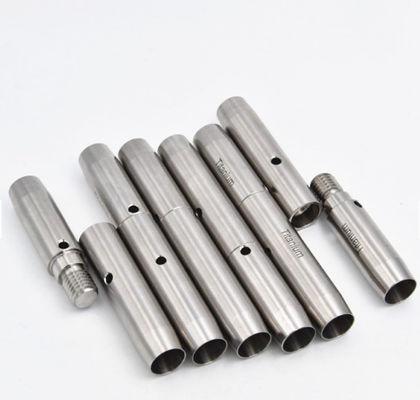
Titanium tube is a hollow titanium product manufactured from titanium billets or titanium alloy materials through processes such as extrusion, piercing, cold drawing, cold rolling, or welding.
Unlike titanium plate, titanium tube already has an internal passage. This makes it particularly useful for applications involving:
Fluid transportation
Heat exchange
Hydraulic systems
Chemical processing
Marine systems
Medical fluid systems
Aerospace structures
Precision mechanical components
From the perspective of Titanium Machining, tube geometry creates additional manufacturing considerations because the component contains both an external surface and an internal surface.
Important parameters include:
Outside diameter
Inside diameter
Wall thickness
Concentricity
Straightness
Internal surface roughness
External surface condition
2. Two Main Titanium Tube Material Systems
Titanium tubes can broadly be divided into two material systems: commercially pure titanium tubes and titanium alloy tubes.
| Category | Raw Material & Process | Main Applications | Key Characteristics | Main Risk |
|---|---|---|---|---|
| Commercially Pure Titanium Tube — TA Series | Titanium billets processed by extrusion, piercing, precision drawing, or welded tube manufacturing | Corrosive fluid transport, heat-exchange equipment | Excellent corrosion resistance; suitable for acidic, alkaline and chloride-containing media | Internal defects can contribute to localized corrosion; material traceability is important |
| Titanium Alloy Tube — TC Series | Titanium alloy billets formed into hollow tubes | High-pressure and high-strength structural piping | High strength and good resistance to cyclic loads | Generally less corrosion-resistant than commercially pure titanium in some environments |
Commercially Pure Titanium Tube
TA-series titanium tubes are primarily selected when corrosion resistance is the main requirement.
Typical applications include:
Chemical fluid systems
Seawater systems
Heat exchangers
Environmental equipment
Electroplating systems
Medical fluid systems
Titanium Alloy Tube
TC-series tubes are selected when higher mechanical strength and structural performance are required.
They can be used for:
High-pressure hydraulic systems
Aerospace hydraulic tubing
Lightweight structural tubes
High-strength mechanical components
However, a high-strength titanium alloy should not automatically replace commercially pure titanium in corrosive environments.
3. Titanium Tube Standards and Common Grades
Material standards are particularly important when titanium tubes are used for critical components.
Common standards include:
| Type | Standard | Standard Description | Typical Application |
|---|---|---|---|
| General Titanium Tube | GB/T 3624-2023 | Titanium and titanium alloy seamless and welded tubes | General industrial titanium tubes, chemical equipment and equipment applications |
| Titanium Heat-Exchange Tube | GB/T 3625-2023 | Titanium and titanium alloy heat-exchange tubes | Thin-wall heat exchanger tubes |
| Seamless Titanium Tube | ASTM B337 | Standard specification for seamless titanium tubes | Export industrial and engineering applications |
| Titanium Heat-Exchange Tube | ASTM B338 | Titanium and titanium alloy seamless tubes for heat exchangers | Seawater desalination and heat-exchanger applications |
These standards may define requirements related to:
Chemical composition
Dimensional tolerances
Wall thickness
Surface quality
Hydrostatic testing
Gas-tightness testing
Mechanical properties
For CNC machining projects, the material certificate should be checked before machining begins to ensure that the supplied material corresponds to the engineering specification.
4. Seamless Titanium Tube vs. Welded Titanium Tube vs. Titanium Capillary Tube
One of the most important distinctions in titanium tube manufacturing is the production method.
| Feature | Seamless Titanium Tube | Welded Titanium Tube | Titanium Capillary Tube |
|---|---|---|---|
| Production | Billet → forging → piercing/extrusion → cold drawing/rolling → heat treatment → finishing | Titanium plate/strip → forming → argon arc welding → sizing | Seamless tube → multiple precision drawing operations |
| Main Advantage | No weld seam; uniform structure; strong pressure and fatigue performance | Shorter production cycle; lower cost; economical for larger diameters | Extremely small diameter and tight dimensional tolerances |
| Limitation | Higher cost; large diameters are more difficult to manufacture | Weld seam can be a mechanically sensitive area | High manufacturing cost |
| Typical Application | High-pressure fluid, heat exchangers, vacuum systems, deep-sea lines | Low-pressure static gas or general corrosion-resistant flow lines | Medical devices, sensors, laboratory systems |
| Key Restriction | Selection based on pressure and operating conditions | Not recommended for high-pressure, high-temperature, cyclic or demanding seawater heat-exchanger applications | Not suitable for high-flow industrial fluid transportation |
Seamless Titanium Tube
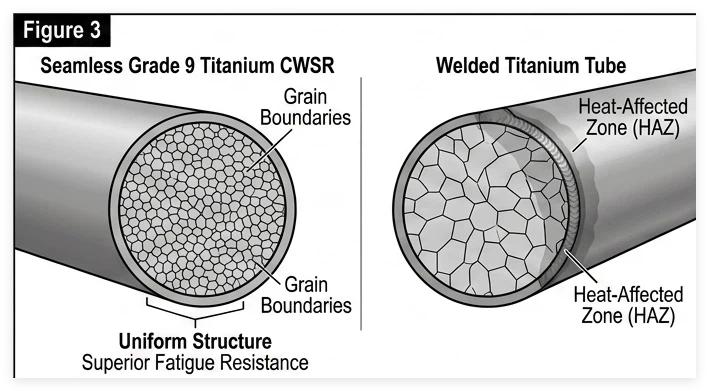
A seamless titanium tube is manufactured without a longitudinal weld seam.
The typical manufacturing sequence is:
Titanium Ingot → Forged Billet → Piercing/Extrusion → Cold Drawing or Cold Rolling → Heat Treatment → Precision Finishing
Its advantages include:
No weld seam
More uniform structure
Good pressure resistance
Good fatigue performance
High reliability in demanding service
Typical applications include:
High-pressure fluid systems
Heat exchangers
Vacuum pipelines
Deep-sea systems
Flammable or explosive media
Seamless tube is generally the preferred choice when the tube will experience significant pressure, temperature variation, vibration, or cyclic loading.
5. Welded Titanium Tube
Welded titanium tube is generally manufactured by forming titanium strip or plate into a cylindrical shape and joining the seam using an appropriate welding process.
A simplified process is:
Titanium Plate/Strip → Slitting → Roll Forming → Argon Arc Welding → Sizing → Finishing
The main advantages are:
Shorter production cycle
Lower production cost
Better cost efficiency for larger diameters
However, the welded region requires particular attention.
The weld can become a mechanically sensitive area, especially when the component is exposed to:
High pressure
High temperature
Cyclic loading
Vibration
Aggressive corrosion
Therefore, welded titanium tube should not simply be considered interchangeable with seamless titanium tube.
For demanding titanium CNC machining and component manufacturing, the tube production method should be specified clearly in the engineering documentation.
6. Titanium Capillary Tube
Titanium capillary tube is a specialized type of seamless tube manufactured through multiple precision drawing operations.
It is generally characterized by:
Very small outside diameter
Small internal diameter
Tight dimensional tolerances
Precision internal geometry
Ultra-fine titanium tubes may have an outside diameter of 10 mm or less.
Typical applications include:
Medical instruments
Sensors
Laboratory equipment
Precision fluid systems
Specialized instrumentation
Because the tube diameter and wall thickness are extremely small, machining and handling require significantly greater precision.
Titanium capillary tubes are generally not intended for high-flow industrial fluid transportation.
 7. Titanium Tube Surface Treatment
The internal surface of titanium tube can be just as important as the external surface.
For fluid-handling applications, internal surface quality directly influences:
Corrosion resistance
Fluid resistance
Fouling
Cleaning
Service life
Pickling of Internal and External Surfaces
Pickling is a basic surface treatment for many industrial titanium tubes.
A titanium-specific pickling solution can remove:
Oxide scale
Surface contamination
Oxygen-enriched brittle layers
The process helps:
Improve surface condition
Reduce localized corrosion risk
Prepare surfaces for welding
Remove undesirable oxide layers
However, pickling should not be considered a replacement for polishing or passivation when those processes are specifically required by the application.
Internal Bright Annealing and Internal Polishing
For applications requiring a high-quality internal surface, titanium tubes may undergo:
Bright annealing under an inert atmosphere
Mechanical honing
Internal polishing
The primary objective is to obtain a smoother internal surface.
Benefits include:
Reduced fluid resistance
Reduced scaling
Improved cleanability
Better internal surface quality
This is particularly relevant for:
Seawater condensers
Precision heat exchangers
Food processing systems
Medical fluid pipelines
For fluid applications, the internal surface should receive particular attention, even when the external surface has less stringent requirements.
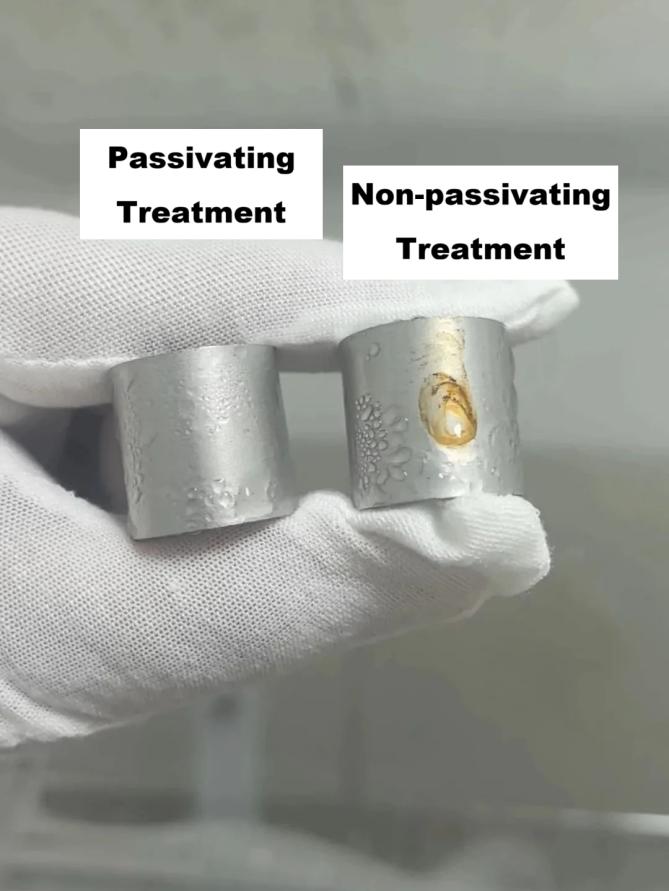
Titanium Tube Passivation
Passivation can chemically stabilize the surface oxide layer and help improve resistance to certain corrosive environments.
It may be considered for:
Seawater applications
High-salt wastewater
Long-term immersion
Chloride-containing environments
Passivation should be regarded as a corrosion-performance upgrade rather than a universal replacement for other surface treatments.
External Sandblasting
External sandblasting produces a matte surface and can:
Improve outdoor appearance
Provide a uniform texture
Help hide machining marks
Improve weathering characteristics
Typical applications include:
Outdoor pipelines
Marine platforms
External piping systems
However, abrasive particles must not be allowed to remain inside the tube.
Tube openings should be properly protected and sealed during external blasting.
titanium anodizing
Titanium anodizing uses an electrochemical oxidation process to modify the surface.
It can provide:
Decorative colors
Improved surface appearance
Improved wear resistance
It may be suitable for:
Small-diameter precision tubes
Capillary tubes
Titanium fittings
Decorative components
It is generally not the primary surface treatment for large fluid-transportation pipelines.
8. TA2 / TA10 vs. TC4 Titanium Tube
Material selection should be based on the actual operating environment.
| Material | Main Advantages | Main Limitation | Typical Applications |
|---|---|---|---|
| TA2 / TA10 | Excellent resistance to seawater, chloride ions and organic acids; good biological compatibility | Lower strength than titanium alloys | Desalination heat exchangers, chemical pipelines, electroplating systems, corrosion-resistant fluid systems, medical fluid components |
| TC4 | High tensile strength, impact resistance and lightweight structural performance | Generally less corrosion-resistant than commercially pure titanium in demanding environments | Aerospace hydraulic systems, high-pressure hydraulic systems, lightweight high-pressure structural tubing |
TA2 / TA10
Commercially pure titanium grades such as TA2 and TA10 are often selected when corrosion resistance is the primary consideration.
Potential applications include:
Seawater desalination
Heat exchangers
Chemical fluid transportation
Electroplating circulation systems
Corrosion-resistant pipelines
Medical fluid systems
TC4
TC4 is selected when mechanical strength and lightweight structural performance are more important.
Typical applications include:
Aerospace hydraulic tubing
High-pressure hydraulic systems
Lightweight pressure-bearing structures
High-performance mechanical components
However, TC4 should not automatically replace TA2 or TA10 in corrosive fluid applications.
9. Titanium Tube Cutting and Machining
When titanium tube is used as a starting material for CNC machining or component fabrication, cutting and workholding require particular attention.
Cutting
Suitable cutting methods may include:
Band saw cutting
Abrasive cutting
CNC cutting
Other application-specific cutting methods
After cutting, the tube ends should be cleaned and deburred.
Potential risks include:
Excessive heat
Oxygen contamination
Burrs
Metallic debris
Internal-surface damage
High-temperature cutting without appropriate control can cause oxygen contamination and embrittlement near the cut surface.
Debris remaining inside the tube can also affect downstream fluid systems and potentially contribute to internal surface damage.
10. Titanium Tube Bending
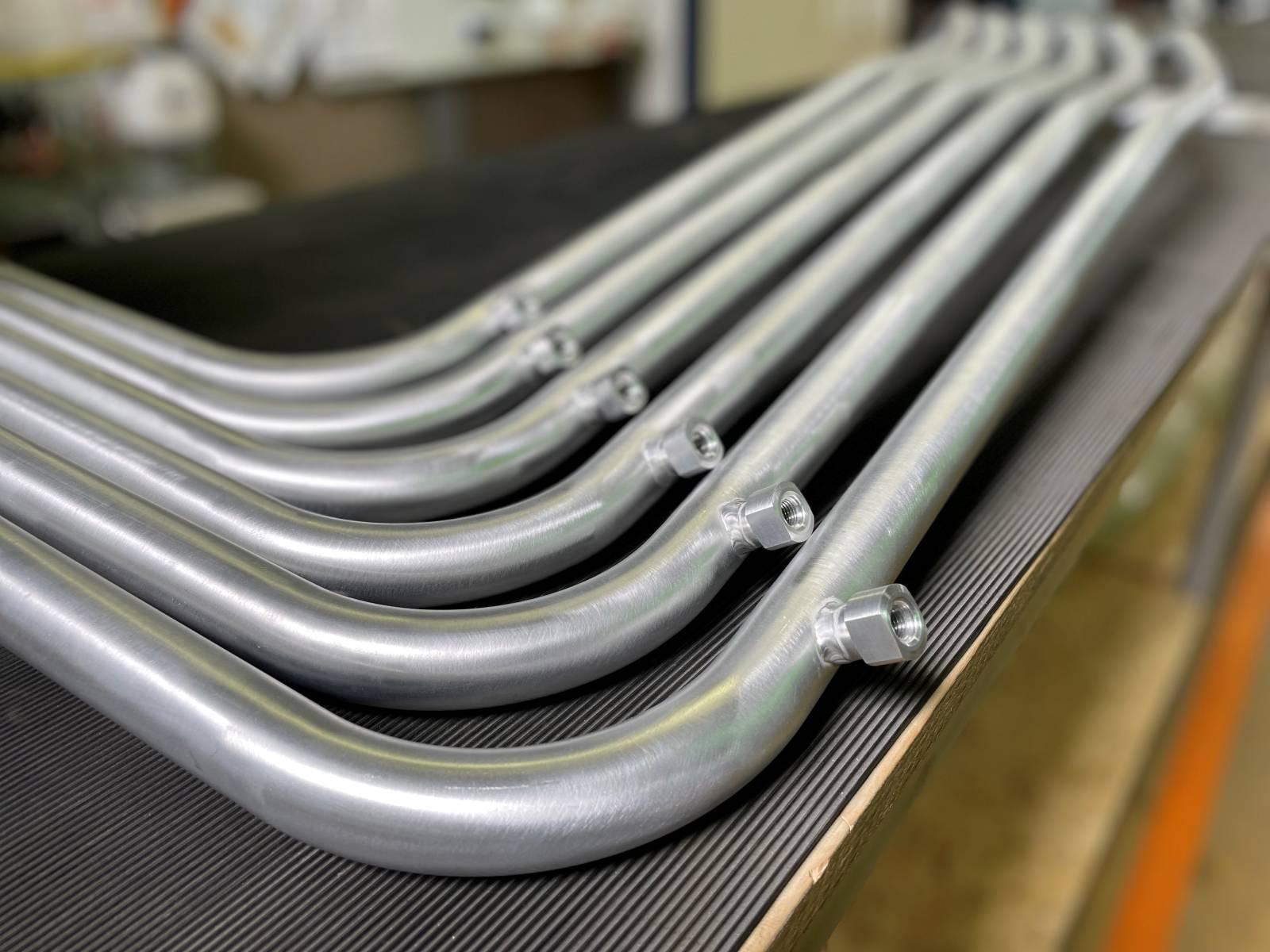
Titanium tube can be bent, but its springback behavior must be considered during forming.
Key considerations include:
Material grade
Tube diameter
Wall thickness
Bend radius
Bending angle
Workholding
Residual stress
For large-angle bends, controlled heating may be considered depending on the material and process.
The bending radius should not be unnecessarily small because excessive deformation can result in:
Local thinning
Ovalization
Cracking
Stress concentration
For demanding applications, stress-relief heat treatment may be considered after bending.
11. Titanium Tube Welding
Titanium welding requires strict atmospheric protection.
During welding, both the external and internal surfaces of the tube should be protected using argon shielding to prevent atmospheric contamination.
The welding process should maintain adequate inert-gas protection throughout the critical high-temperature stage.
A practical visual indicator is weld color.
If the titanium weld becomes:
Yellow
Blue
Purple
Darkened
it may indicate inadequate shielding and atmospheric contamination.
In such cases, the affected area may require removal and re-welding according to the applicable welding procedure.
After welding, the weld region may also require pickling or other appropriate surface treatment.
Poor shielding can significantly reduce weld ductility and increase the risk of cracking and leakage.
12. Titanium Tube CNC Machining Considerations
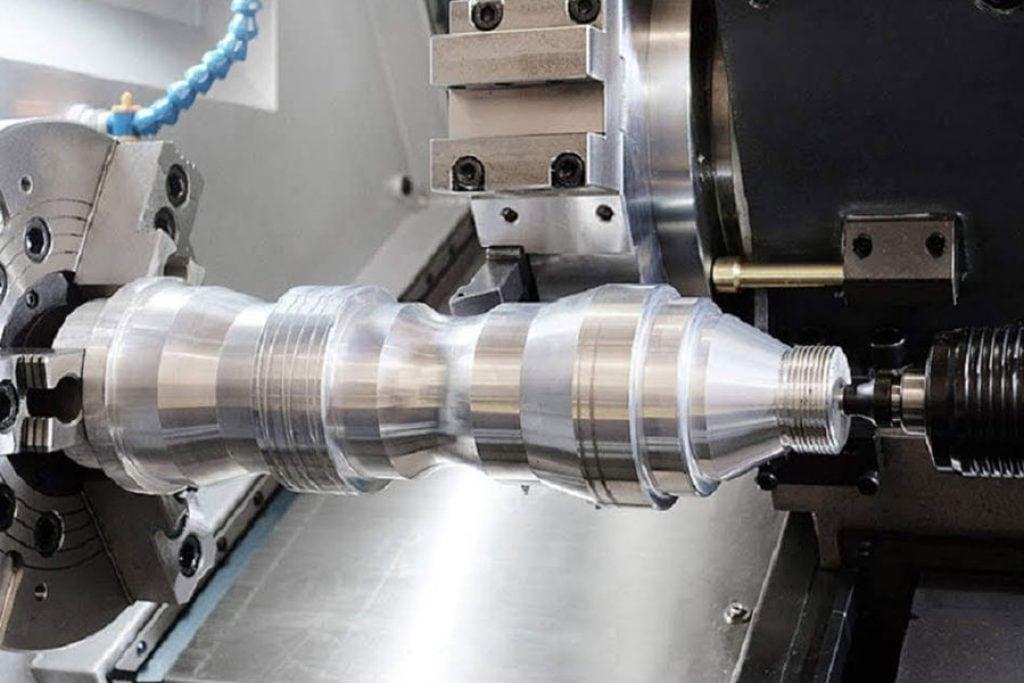
Although tubes are already hollow, they can still require CNC machining for precision components.
Typical CNC operations include:
CNC turning
CNC milling
Drilling
Boring
Thread machining
Groove machining
End-face machining
Port machining
Precision finishing
For titanium alloy tubes such as TC4, machining parameters need to account for:
Low thermal conductivity
High cutting forces
Tool wear
Work hardening
Vibration
Thin-wall deformation
For complex tube fittings and titanium components, 5-axis CNC machining may be used to access angled surfaces and complex geometries with fewer setups.
The machining strategy should be designed around the actual tube geometry rather than treating the material like a conventional steel or aluminum tube.
13. Titanium Tube Inspection
Before a titanium tube enters machining or assembly, several inspection items should be considered.
Dimensional Inspection
Check:
Outside diameter
Inside diameter
Wall thickness
Straightness
Concentricity
Wall thickness should be measured at multiple points to identify potential eccentricity or uneven wall thickness.
Surface Inspection
Both internal and external surfaces should be checked for:
Cracks
Peeling
Scratches
Dents
Corrosion damage
For welded tubes, the weld should be checked for:
Porosity
Incomplete penetration
Surface defects
Abnormal weld geometry
For seamless tubes, continuous grinding marks that could indicate a repaired or disguised weld should be treated carefully.
Pressure Testing
For pressure-bearing applications, the relevant hydrostatic test report should be available.
For vacuum systems, gas-tightness testing may also be required.
Material Certification
The material should be accompanied by an original material certificate containing relevant information such as:
Material grade
Chemical composition
Mechanical properties
Batch/heat number
Applicable standard
For suspicious materials, chemical composition can be verified through material analysis or spectroscopy.
14. Common Problems When Selecting Titanium Tube for Machining
The following issues are particularly important when titanium tube becomes part of a CNC machining or component-manufacturing project.
Seamless vs. Welded Tube
Heat exchangers, high-pressure systems, and demanding marine applications may require seamless titanium tubes.
A welded tube should not be treated as equivalent simply because the outside dimensions are the same.
Special attention should also be paid to products where a weld has been ground to imitate a seamless tube.
Do Not Specify Only OD × Wall Thickness
A titanium tube specification should also clarify:
Seamless or welded
Titanium grade
Applicable standard
Internal surface treatment
Pickling requirements
Passivation requirements
Internal polishing requirements
High-Chloride Applications
For demanding seawater and chloride environments, TA10 may be considered where appropriate.
Material selection should account for actual chloride concentration, temperature, flow conditions, and exposure time.
Thin-Wall Heat-Exchange Tubes
Thin-wall titanium heat-exchange tubes can deform if excessive external clamping force is applied.
Workholding must therefore be carefully controlled during machining and assembly.
Heat-Exchange Tube vs. General Industrial Tube
GB/T 3625 heat-exchange titanium tube is not simply interchangeable with general industrial titanium tube under GB/T 3624.
Heat-exchange applications can have more stringent requirements for:
Internal diameter
Wall thickness
Dimensional accuracy
Internal surface roughness
TC4 Is Not a Universal Replacement for TA2
TC4 provides higher strength, but higher strength does not automatically mean better corrosion performance.
For corrosive fluid systems, the titanium grade should be selected based on the actual operating environment.
15. How Titanium Tube Selection Affects CNC Machining
For a CNC machining manufacturer, material selection should follow the component requirements rather than the other way around.
A practical selection sequence is:
1. Determine the Application
↓
2. Determine Pressure / Temperature / Corrosion Conditions
↓
3. Select Seamless or Welded Tube
↓
4. Select Titanium Grade
↓
5. Determine OD / ID / Wall Thickness
↓
6. Define Internal and External Surface Treatment
↓
7. Develop CNC Machining Process
↓
8. Perform Dimensional and Functional Inspection
This approach prevents the common mistake of selecting a material based only on outside diameter and wall thickness.
16. Key Titanium Tube Selection Rules
For practical engineering applications, several basic rules can be followed.
Normal-Pressure Static Applications
Welded titanium tube may be considered when the operating conditions are relatively mild and cost optimization is important.
Heat Exchangers, High Pressure and Marine Applications
Seamless titanium tube is generally preferred when pressure, cyclic loading, vibration, or demanding corrosion conditions are involved.
High-Chloride Seawater Conditions
A suitable commercially pure titanium grade such as TA10 should be evaluated rather than automatically selecting TA2.
Precision Applications
Internal surface quality can be just as important as material grade.
Consider:
Internal polishing
Internal roughness
Cleanliness
Dimensional tolerance
Straightness
CNC Machining
The machining process should account for:
Wall thickness
Tube rigidity
Workholding pressure
Cutting force
Tool accessibility
Internal geometry
Titanium tube is an important material form for producing high-performance components used in aerospace, chemical processing, marine systems, heat exchangers, medical equipment, hydraulic systems, and other demanding applications.
From a CNC machining and Titanium Alloy Machining perspective, titanium tube selection should not be based solely on dimensions.
The manufacturing method—seamless, welded, or capillary—the titanium grade—TA2, TA10, TC4, etc.—the applicable standard, wall thickness, internal surface quality, surface treatment, and operating environment can all influence the performance of the final component.
For precision titanium components, machining considerations are equally important. Titanium's low thermal conductivity, high strength, tool-wear characteristics, and tendency toward deformation or vibration require carefully controlled cutting parameters, workholding, tooling, and inspection.
For complex titanium tube components, CNC turning, CNC milling, and 5-axis CNC machining can be combined to produce accurate interfaces, ports, mounting features, and complex geometries.
Ultimately, the objective is not simply to select or purchase a titanium tube. It is to select the appropriate titanium material and manufacturing condition and then convert it into a precision CNC machined titanium component that meets the required dimensional, mechanical, corrosion-resistance, and functional requirements.


